Understanding Your Average Composition Shingle Roof Cost in 2026
When calculating your total composition shingle roof cost, the primary metric used across the roofing industry is the “square.” One roofing square equals 100 square feet of roof surface area. For homeowners comparing bids in Boise and the Treasure Valley, working with a transparent Boise roofing contractor helps ensure the estimate reflects roof size, tear-off requirements, code-required accessories, and installation quality. If you are planning a full roof replacement, Kings Roofing & Contracting provides itemized pricing so hidden fees do not appear after the job starts. For example, a typical 2,000-square-foot home requiring about 20 squares before waste factor will often see total baseline costs start between $7,000 and $12,600 for standard architectural materials.
Across the United States, baseline unit pricing typically averages between $6.20 and $8.02 per square foot for mid-range, non-discounted fiberglass laminated shingles. However, local market conditions cause significant variations. According to localized trade data, homeowner research platforms such as Homewyse Composition Shingle Roof Estimates show how regional material transportation, contractor overhead, and local labor rates dictate local estimates.
To get an accurate picture of your project, you must calculate total finished surface area, which is always larger than your home’s ground footprint due to roof slope. You can easily calculate your baseline budget using our online tool to Get Your Roof Replacement Cost Estimate.
Breakdown of Architectural Composition Shingle Roof Cost Per Square Foot
Architectural composition shingles, also known as dimensional or laminated shingles, are built on a tough fiberglass mat core engineered by leading industry manufacturers like GAF. This core is coated with asphalt and embedded with ceramic-coated mineral granules to deliver fire resistance and protection against UV degradation.
Standard fiberglass-based architectural shingles cost $4.00 to $7.00 per square foot installed. Material costs account for roughly $2.50 to $3.50 per square foot, while installation labor adds another $1.50 to $3.50 per square foot depending on crew experience and site conditions. Because they offer superior wind resistance, often rated up to 110 to 130 mph, and a 25-to-40-year lifespan, architectural shingles represent the vast majority of residential installations today. To dive deeper into material costs, read our detailed guide on Shingle Roof Replacement Costs Explained Without the Sticker Shock.
Composition vs. Composite Shingles Clarified
Homeowners frequently confuse the terms “composition” and “composite,” but in modern roofing, they refer to distinct material classes:
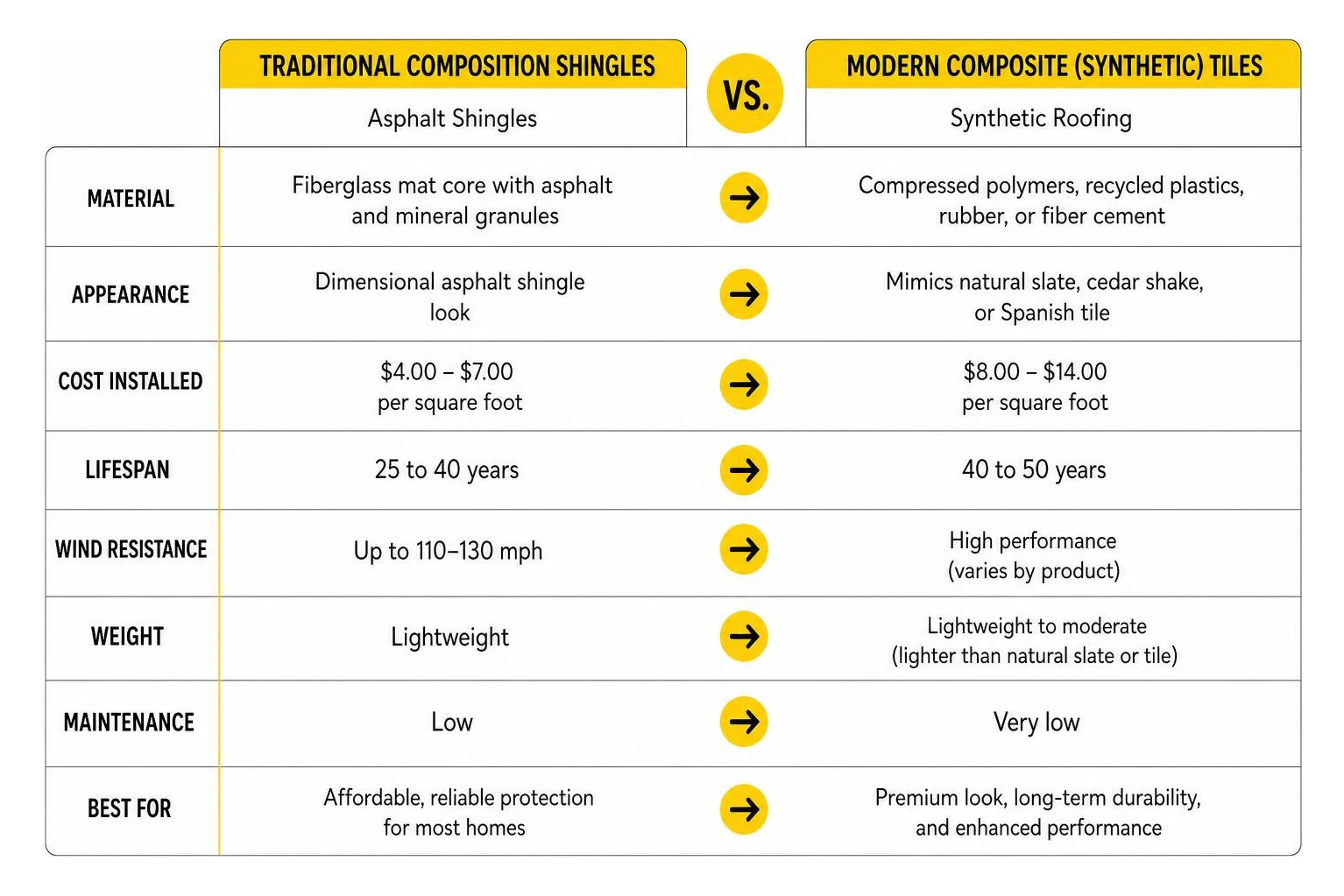
- Traditional Composition Shingles: These are traditional asphalt shingles made from a composite matrix of fiberglass, asphalt, and mineral granules. They are the most common roofing option in the U.S. due to their reliability and affordability.
- Modern Composite (Synthetic) Shingles: These are premium synthetic products manufactured from compressed polymers, recycled plastics, rubber, or fiber cement. Engineered by manufacturers such as DaVinci, Brava, and EcoStar to mimic natural slate, cedar shake, or Spanish tile, synthetic polymer-based composite shingles cost $8.00 to $14.00 per square foot installed and last 40 to 50 years.
If you are weighing basic options, read our breakdown on The Great Shingle Showdown: 3-Tab vs Architectural to understand how performance differs across entry-level materials.
Factors That Drive Total Installation Costs
Your total invoice is driven by specific structural, geographical, and logistical variables. Labor typically accounts for 50% to 60% of the complete installation cost.
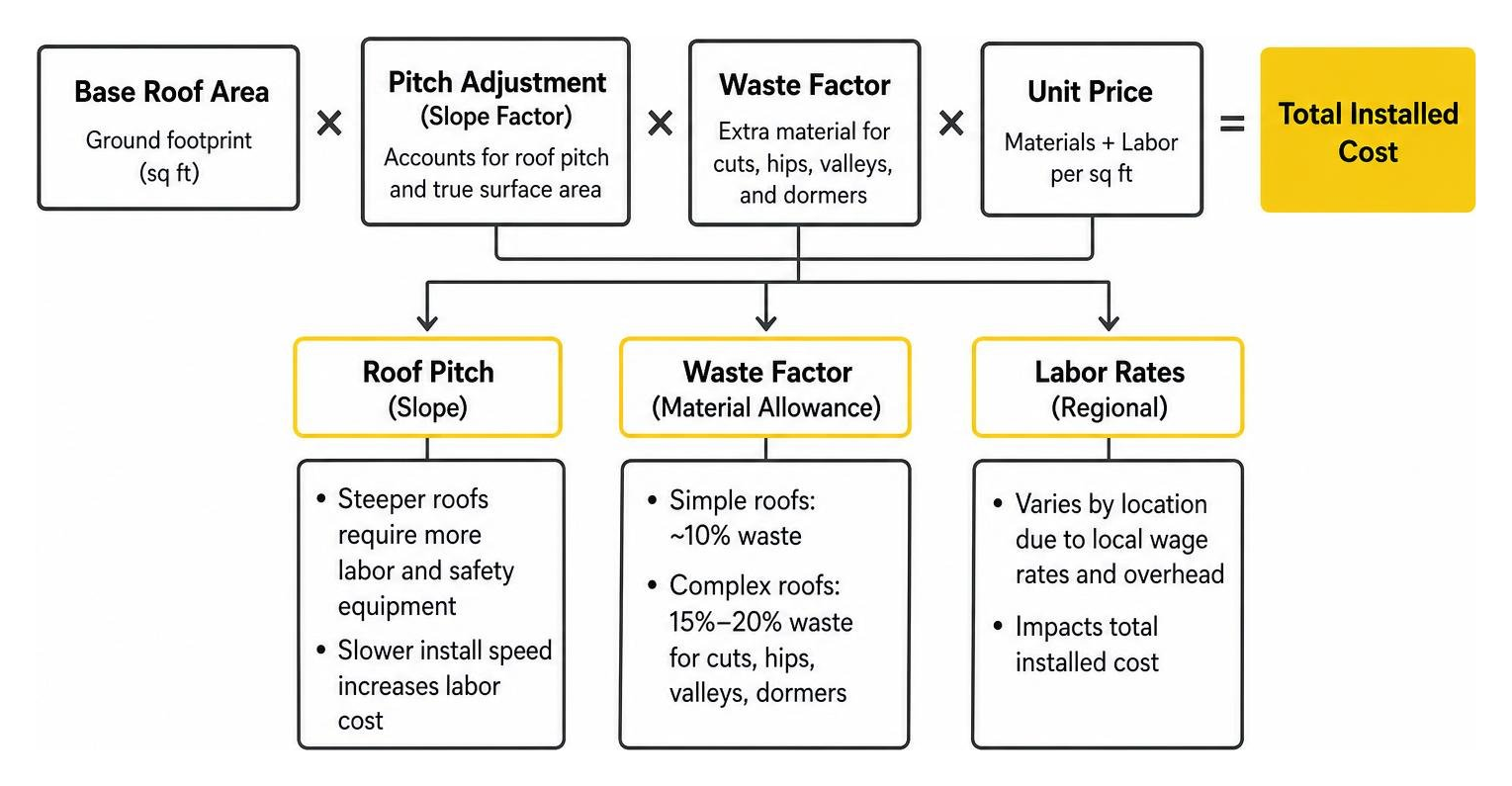
Key factors include:
- Roof Pitch (Slope): Steeper roofs (typically a 7/12 pitch or higher) require specialized safety staging, harnesses, and slower installation speeds. Crews often charge an additional $20 to $50 per square for steep-pitch safety requirements.
- Architectural Complexity: A simple gabled roof requires less time and material cutting than a complex roof with multiple dormers, valleys, skylights, and chimneys.
- Waste Factor: Valleys, hips, and dormers require cutting shingles to fit. standard roofs require a 10% waste allowance, while complex roofs require 15% to 20% extra material.
- Regional Labor Rates: Labor rates vary by region. For instance, data from the ProMatcher Nampa ID Roofing Cost Report indicates that local labor rates in Nampa, Meridian, and Boise reflect specific regional supply chain and wage structures that impact total project costs.
Old Roof Removal and Disposal Fees
Tearing off existing roofing layers is a significant line item that adds $1.00 to $3.00 per square foot ($100 to $300 per square) to the project total.
Tear-off and disposal cost considerations include:
- Number of Layers: Tearing off a single layer of asphalt shingles is standard. Tearing off two or more layers increases labor time and total dumping weight, driving up disposal costs.
- Dumpster Fees: Roll-off dumpsters and municipal landfill tipping fees typically run between $300 and $600 per job, depending on weight.
- Decking Repairs: Once the old roof is removed, damaged plywood or OSB decking must be replaced. Decking replacement costs $2.00 to $5.00 per square foot ($40 to $80 per 4×8 sheet installed).
Essential Accessory Costs: Underlayment, Flashing, and Permits
A high-performing roof requires an engineered system, not just shingles laid on plywood. Key system accessories include:
- Synthetic Underlayment: Modern synthetic underlayment provides superior tear resistance and moisture protection compared to traditional organic felt paper, adding $0.15 to $0.35 per square foot.
- Ice and Water Shield: Crucial in regions subject to ice damming and freeze-thaw cycles. Code requires self-adhering ice and water membrane along eaves, valleys, and penetrations, adding $0.50 to $1.20 per linear foot.
- Flashing and Drip Edge: Replacing metal drip edges, step flashing around chimneys, and wall flashing costs between $2.00 and $5.00 per linear foot.
- Pipe Boots: Rubber or lead plumbing vent boots dry out over time and should always be replaced during a reroof ($30 to $75 each).
- Municipal Permits: Building permits ensure your installation meets local building codes. Permit fees typically range from $100 to $400 depending on your municipality.
For local property owners, our guide No More Leaks: The Ultimate Guide to Asphalt Shingles in Boise breaks down local climate considerations.
How Composition Shingles Compare to Alternative Materials
When evaluating your initial expenditure against long-term lifecycle performance, composition shingles strike an optimal balance between affordability and longevity.
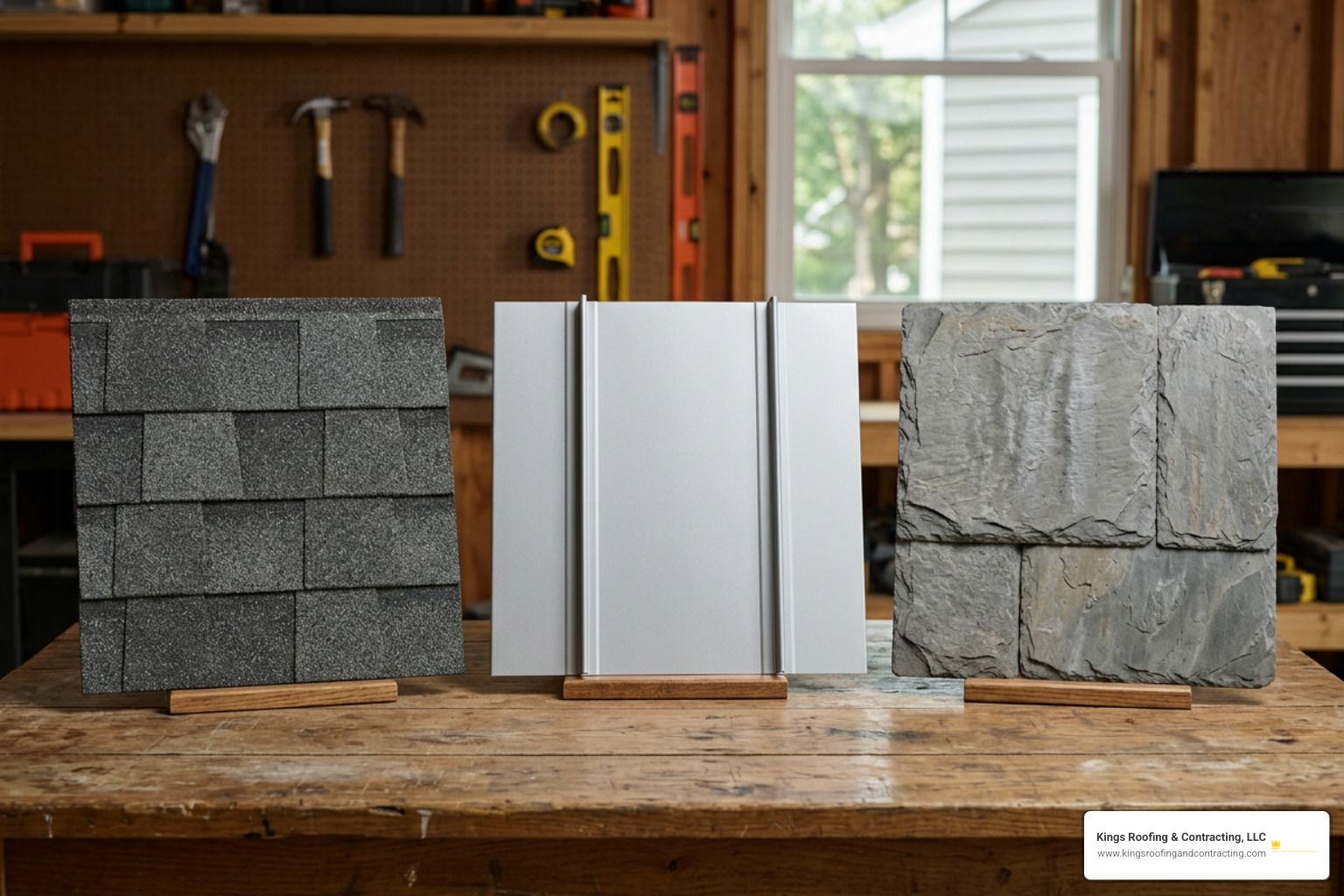
| Roofing Material | Cost Per Sq Ft (Installed) | Average Lifespan | Fire Rating | Maintenance Needs |
|---|---|---|---|---|
| Architectural Composition Shingles | $4.00 – $7.00 | 25 – 40 Years | Class A | Low |
| Premium Synthetic Composite | $8.00 – $14.00 | 40 – 50 Years | Class A | Very Low |
| Metal (Standing Seam) | $8.00 – $15.00+ | 40 – 70 Years | Class A | Very Low |
| Natural Cedar Shake | $8.00 – $14.00 | 20 – 30 Years | Class B / C | High |
| Clay / Concrete Tile | $12.00 – $25.00 | 50 – 100 Years | Class A | Moderate |
| Natural Slate | $15.00 – $35.00+ | 75 – 100+ Years | Class A | Low |
Comparing Composition Shingle Roof Cost to Synthetic and Natural Materials
Installed cost, structural requirements, and maintenance demands make composition shingles the practical benchmark for most residential roof replacement budgets. When all materials are compared by installed square-foot cost, asphalt-based architectural composition shingles remain one of the lowest-cost Class A fire-rated roof systems available for typical homes.
- Metal Roofing: While standing seam metal roofs offer long lifespans, they often cost nearly double upfront at $8.00 to $15.00+ per sq. ft. The financial payback period for metal versus architectural composition roofing is commonly measured in decades, which often exceeds average homeownership timelines.
- Natural Slate and Tile: Natural slate at $15.00 to $35.00+ per sq. ft. and concrete tile at $12.00 to $25.00 per sq. ft. may require upgraded structural roof framing because of their heavy dead load. Synthetic composite tiles deliver a similar luxury aesthetic with less weight than many natural stone or tile systems.
- Cedar Shake: Real wood shake at $8.00 to $14.00 per sq. ft. requires regular maintenance and may face fire-rating restrictions depending on product treatment and local code. Class A fire-rated synthetic composite shakes offer a realistic alternative without the same maintenance demands.
Lifespan, Warranties, and Home Value ROI
A modern composition shingle roof is an investment in your home’s thermal envelope and structural health. Standard architectural composition shingles last 25 to 40 years, while polymer-based composite shingles last 40 to 50 years with minimal maintenance.

Key performance factors that boost value include:
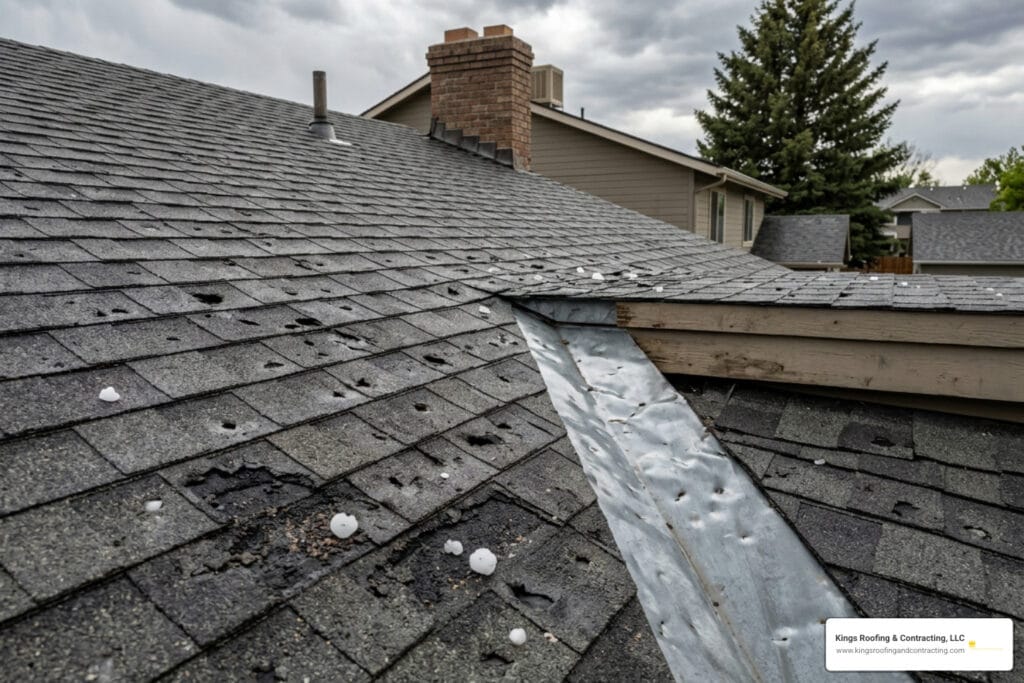
- Class 4 Impact Resistance: Upgrading to UL 2218 Class 4 impact-resistant architectural shingles costs an additional $1.00 to $2.00 per square foot, but can qualify homeowners for a 15% to 30% annual discount on homeowner’s insurance premiums in hail-prone regions.
- Wind Resistance: Architectural shingles carry UL wind resistance ratings of 110 mph to 130 mph (Class F or H), protecting against severe windstorms.
- Return on Investment (ROI): According to national cost-vs-value reports, a standard shingle Roof Replacement yields a direct ROI of approximately 60% to 65% in home resale value.
Manufacturer warranties generally fall into two categories: standard limited warranties (covering defect protection for 25 to 30 years) and extended non-prorated system warranties. Because Kings Roofing & Contracting is a GAF-certified contractor, we provide factory-backed non-prorated system warranties that cover materials and installation labor, transferable to future home buyers.
Frequently Asked Questions About Composition Roofing
How much does a composition shingle roof cost for a 2,000 square foot home?
For a standard 2,000-square-foot roof footprint (requiring roughly 22 to 24 squares of material including waste), a standard architectural composition shingle replacement costs between $7,000 and $12,600. Premium polymer synthetic composite shingles on the same home range from $11,300 to $21,600.
How long do composition shingle roofs last?
Standard architectural composition shingles last 25 to 40 years when properly installed with effective attic ventilation. Synthetic polymer composite shingles last 40 to 50 years. Lifespan depends heavily on attic ventilation, roof pitch, and severe weather exposure.
Do composition shingles increase home energy efficiency and value?
Yes. Modern composition shingles incorporate solar-reflective granules that lower roof surface temperatures, reducing attic heat build-up and air conditioning loads during hot summer months. Installing a new composition shingle roof increases home curb appeal and yields nearly a 60% return on investment at resale.
Conclusion
Understanding your overall composition shingle roof cost comes down to knowing what goes into your quote—from shingle selection and tear-off labor to underlayment, flashing, and local permit fees. By breaking down costs upfront, you can select the right roofing system for your home without worrying about unexpected expenses.
At Kings Roofing & Contracting, LLC, we provide transparent, itemized quotes backed by GAF-certified workmanship across Boise, Meridian, Nampa, Caldwell, Eagle, Kuna, and the surrounding Treasure Valley.
Ready to plan your roof replacement with complete price transparency? Request your Free Roof Quote online to get an accurate estimate from our team.