What to Do When Your Roof Takes a Hit from Hail
Hail damage on a roof is one of the most costly and misunderstood problems a homeowner can face — and it often goes unnoticed until a leak shows up months later. If you suspect your home has been hit, partnering with a trusted Boise roofing contractor immediately can save you thousands in long-term water damage.
Here is a quick summary of what you need to know:
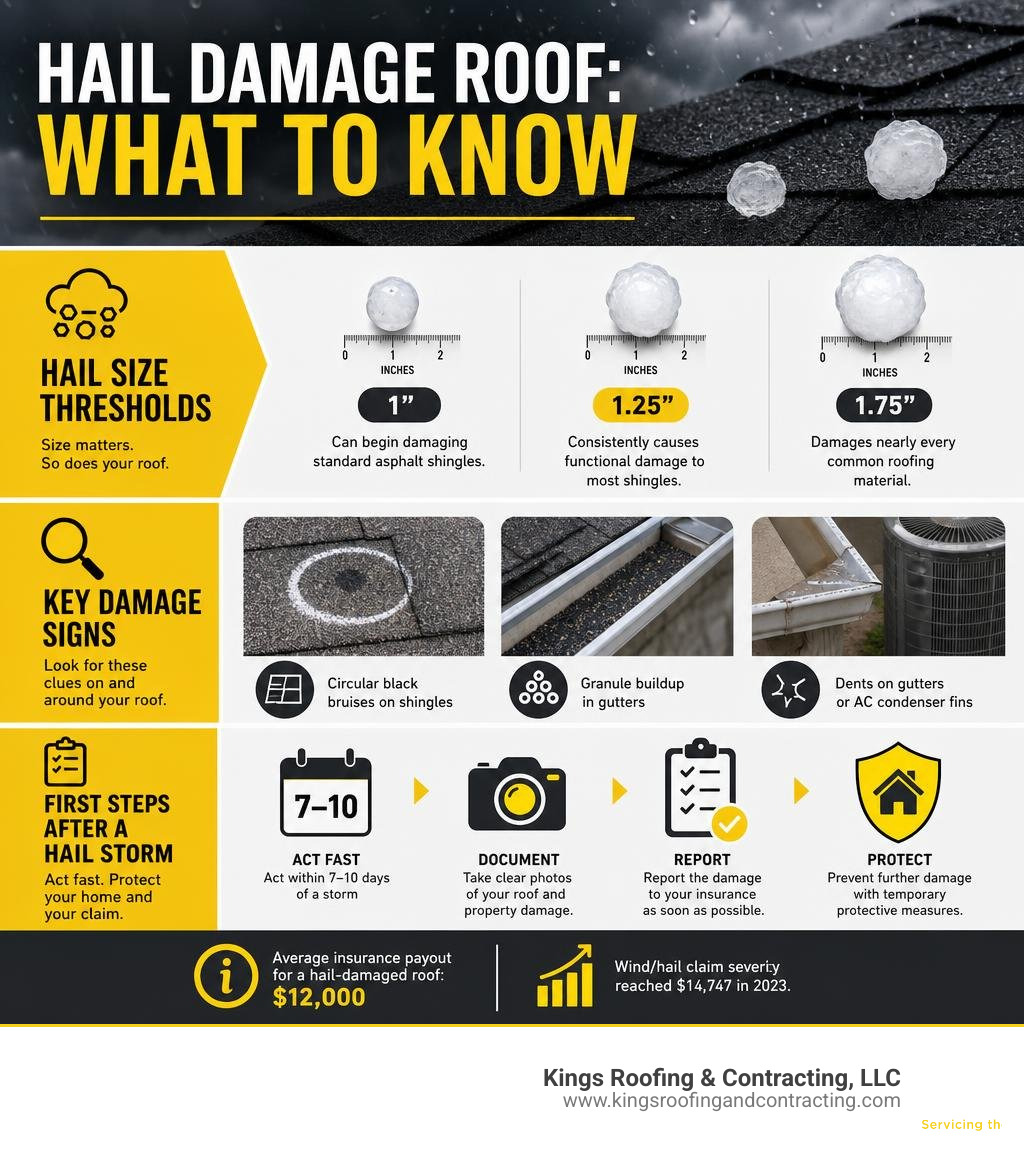
- Hail at 1 inch in diameter can begin damaging standard asphalt shingles
- Hail at 1.25 inches consistently causes functional damage to most shingles
- Hail at 1.75 inches damages nearly every common roofing material
- Key signs of damage include circular black bruises on shingles, granule buildup in gutters, and dents on gutters or AC condenser fins
- Act within 7–10 days of a storm — document damage with photos before evidence washes away
- Average insurance payout for a hail-damaged roof runs around $12,000, though wind/hail claim severity reached $14,747 in 2023
Severe convective storms caused $51 billion in U.S. insured losses in 2025 — the third straight year above that mark. Hail alone accounts for up to 80% of those claims. And roofs absorb 70% to 90% of all insured residential catastrophe losses.
The problem is that hail damage does not always announce itself. Shingles can look intact from the ground while the fiberglass mat underneath is already fractured. Leaks can take 12 to 18 months to appear — often long after your insurance window has closed.
That is why knowing what to look for, and acting quickly, matters so much.
I’m Ryan Santoro, owner of Kings Roofing & Contracting and a roofing professional with 24 years of construction experience, including extensive work in hail damage roof repair across the Treasure Valley. In this guide, I’ll walk you through exactly how to spot hail damage, understand your insurance coverage, and make smart decisions before a small problem becomes a very expensive one.
How to Identify Hail Damage Roof Issues
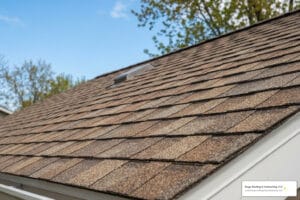
Identifying actual hail damage roof issues requires looking past the surface. On standard asphalt shingles, hail damage does not usually look like a clean hole or a massive tear. Instead, it presents as physical trauma to the shingle’s multi-layered structure.
Standard asphalt shingles consist of a glass-fiber or organic mat, a layer of asphalt, limestone fillers, and a top coating of ceramic granules. When a high-velocity hailstone strikes, it crushes this structure.

To spot real hail damage on asphalt shingles, look for these specific indicators:
- Granule Displacement: The primary defense of an asphalt shingle is its layer of ceramic granules, which protects the underlying asphalt from harmful ultraviolet (UV) rays. Hail impacts knock these granules loose, exposing the dark asphalt underneath.
- Exposed Fiberglass Mat: In severe cases, the impact completely strips away both the granules and the asphalt layer, exposing the underlying fiberglass matting. This matting often appears as a light gray or white woven mesh.
- Asphalt Bruising: When hail strikes, it creates a “bruise” in the shingle. This is a circular, dark soft spot where the asphalt has fractured.
- Tactile Soft Spots: Much like a bruise on an apple, these impact points feel soft and spongy to the touch. If you press your thumb against the center of a suspected strike mark, the shingle will give way slightly because the underlying structure has been crushed.
- Random Strike Patterns: Hail strikes do not follow a pattern. They occur randomly across the roof slopes that faced the oncoming storm. If you notice uniform marks or straight lines of damage, you are likely looking at a different issue.
For a comprehensive breakdown of these visual markers, refer to this detailed hail damage roof guide.
Differentiating Wear and Tear from Hail Damage Roof Issues
It is incredibly common for homeowners—and even some inexperienced inspectors—to mistake normal roof aging for storm damage. However, insurance adjusters are trained to spot the difference immediately. Filing a claim for normal wear and tear can result in a quick denial and an unnecessary claim on your record.
Here is how you can tell the difference between standard deterioration and storm-induced damage:
- Roof Blistering: Blisters occur when moisture becomes trapped inside the shingle during manufacturing or due to poor attic ventilation. Under the summer heat, this moisture expands, popping the surface and leaving small, circular craters. Unlike hail impacts, blisters are usually uniform, have raised edges, and reveal a shiny, glazed asphalt surface beneath. They lack the soft, bruised matting characteristic of a hail strike.
- Thermal Cracking: As roofs age, they expand and contract with temperature swings. This results in long, horizontal cracks across the shingles. These cracks are structural and occur over years, whereas hail fractures are isolated, circular, and localized to the point of impact.
- Manufacturing Defects: Issues like “scuffing” (which happens during installation) or chemical anomalies usually present in uniform patterns across the entire roof, rather than on specific slopes exposed to storm winds.
- Algae and Lichen Growth: Dark streaks caused by algae can mimic the dark spots of granule loss from a distance. However, algae sits on top of the granules, whereas hail damage physically removes the granules to expose the underlying asphalt.
If you suspect your roof has suffered true storm damage rather than typical aging, scheduling a professional inspection with our team for roof repair services is the safest way to get an accurate, honest assessment.
Long-Term Risks of an Unrepaired Hail Damage Roof
Ignoring hail damage because your roof “isn’t leaking yet” is a dangerous gamble. Hail damage is a progressive problem. When a hailstone fractures the fiberglass mat of a shingle, it destroys the shingle’s structural integrity.
Over the next 12 to 18 months, the following cycle occurs:
- Accelerated UV Degradation: With the protective granules knocked away, the sun’s UV rays bake the exposed asphalt. This causes the asphalt to dry out, crack, and curl.
- Adhesive Seal Failure: The physical impact of hail often breaks the adhesive seal between shingle courses. Once this bond is broken, normal winds can easily lift and tear the shingles away.
- Latent Leaks: As the cracked asphalt completely degrades, water begins to seep through the fractured matting. By the time you notice water stains on your ceiling, the roof deck underneath has likely been rotting for months.
- Mold and Structural Rot: Persistent, hidden moisture leads to toxic mold growth in your attic, ruined insulation, and rotted plywood decking.
Addressing these issues early is critical. If your home has recently been through a major storm, securing emergency storm damage roofing services can prevent a simple spot repair from turning into a complete structural rebuild.
Hailstone Size and Material Vulnerability
Not all hailstorms are created equal, and different roofing materials react differently to impacts. The size of the hailstone is the primary predictor of whether your roof has sustained functional damage.
| Hail Size (Diameter) | Visual Comparison | Impact on Roofing Materials | Typical Damage Severity |
|---|---|---|---|
| 0.25″ to 0.50″ | Pea to Marble | Rarely damages roofing; may cause minor granule loss on very old, brittle asphalt shingles. | Cosmetic only; monitor. |
| 0.75″ to 1.00″ | Dime to Quarter | Can damage lightweight composite shingles and older, deteriorated asphalt. | Threshold for functional damage. |
| 1.25″ | Half-Dollar | Damages standard 3-tab and architectural asphalt shingles; denting on metal vents. | Consistent functional damage. |
| 1.50″ to 1.75″ | Ping Pong to Golf Ball | Damages heavy composite, wood shakes, and clay tiles; severe denting on metal roofs. | High risk of widespread failure. |
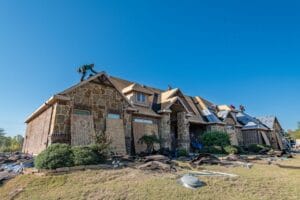
| 2.00″+ | Hen Egg to Tennis Ball | Causes major structural damage; punctures roof decking, skylights, and shatters tile/slate. | Full replacement required. |
As noted in the NRCA hailstorm repair guidelines, hail must generally be at least 1.25 inches in diameter to damage heavy composite shingles or wood shake shingles, while lightweight composite shingles may show damage after being struck by 1-inch hail. Once hail reaches 1.75 inches, almost all standard residential roofing systems will suffer functional compromise.
Upgrading to Class 4 Impact-Resistant Shingles
If your roof has sustained significant damage and requires a full replacement, you should strongly consider upgrading to Class 4 impact-resistant (IR) shingles.
To achieve a UL 2218 Class 4 rating, shingles must withstand a rigorous laboratory test where a 2-inch steel ball is dropped twice from a height of 20 feet onto the exact same spot without cracking the backing of the shingle. Standard shingles would shatter under this test, but Class 4 shingles are modified with rubberized polymers (SBS) that allow them to flex and absorb the impact.
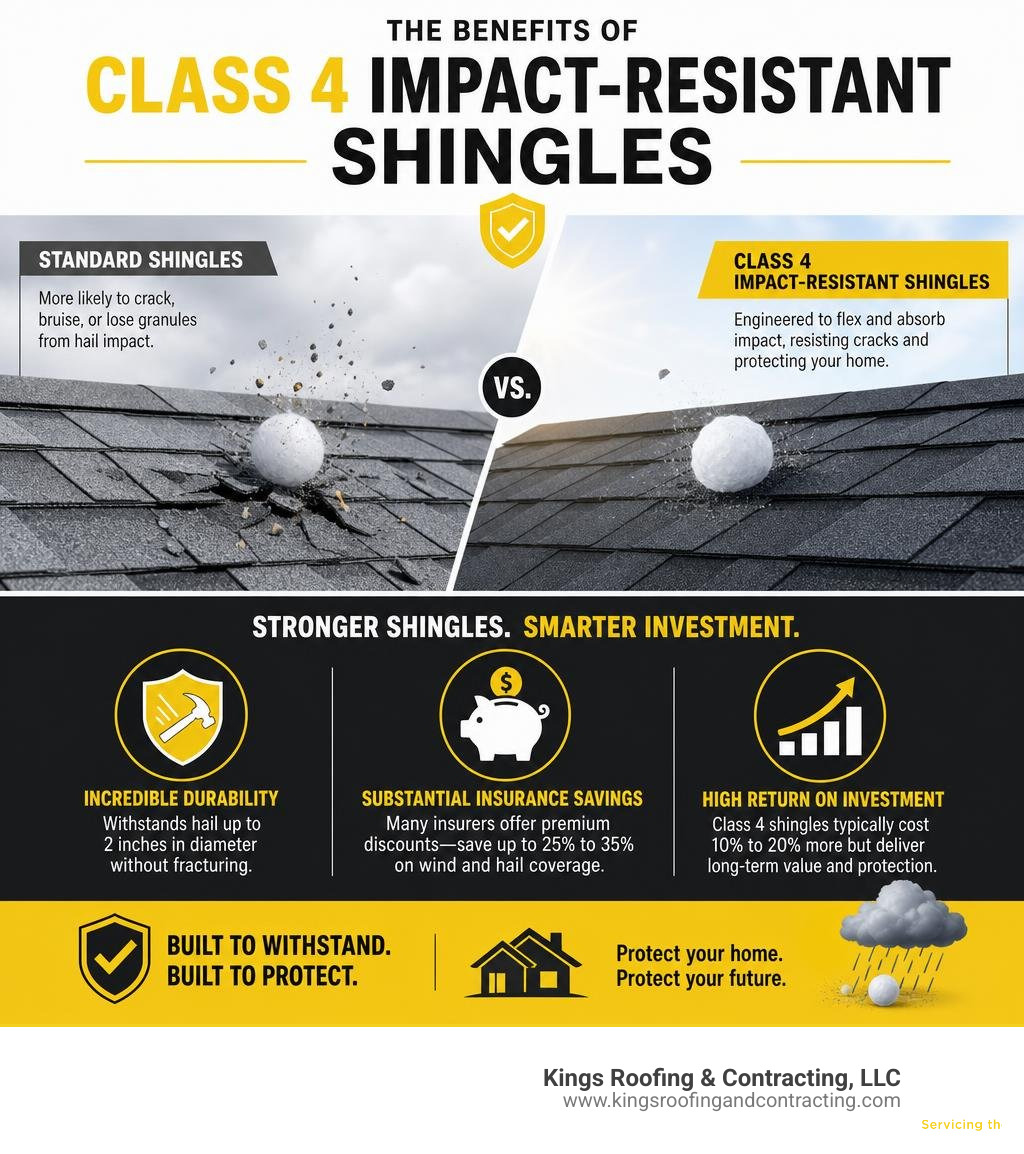
The benefits of upgrading to Class 4 shingles include:
- Incredible Durability: They can easily withstand hail up to 2 inches in diameter without fracturing, significantly extending the lifespan of your roof.
- Substantial Insurance Savings: Because these roofs are highly resilient, many insurance carriers offer premium discounts. In some states, homeowners can save up to 25% to 35% on their wind and hail premiums, with full IBHS FORTIFIED Roof certifications yielding even higher discounts.
- High Return on Investment: While Class 4 shingles typically cost 10% to 20% more than standard architectural shingles, the hazard mitigation math is clear: every $1 spent on hazard mitigation can save up to $33 in future disaster losses.
When planning your storm restoration, exploring these roof replacement options can save you thousands of dollars over the life of your home.
Safe Inspection Methods and Ground-Level Signs
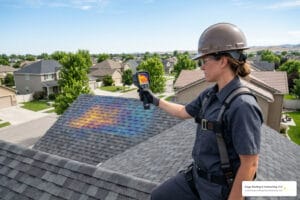
We cannot emphasize this enough: do not climb onto your roof after a hailstorm. A roof that has just been pelted by hail is highly dangerous. Loose granules act like ball bearings underfoot, and weakened decking can collapse.
Fortunately, you can conduct a highly effective preliminary inspection right from the safety of the ground.
Walk the perimeter of your home and look for these clear ground-level indicators of roof damage:
- Dented Gutters and Downspouts: Gutters are made of soft aluminum. If hail was large enough and heavy enough to dent your gutters, it was absolutely large enough to damage your shingles.
- Granule Accumulation: Check your gutter downspout splash blocks. If you see piles of ceramic granules that look like dark sand, it means the hail has stripped the protective layer off your shingles.
- Dented AC Condenser Fins: Walk over to your outdoor air conditioning unit. If the thin metal cooling fins are smashed or dented, you have clear evidence of high-impact hail.
- Torn Window Screens and Mailbox Dents: Look at your window screens for tears or circular impact marks. Check the top of metal mailboxes or light fixtures for fresh dents.
- Fallen Shingle Pieces: Look around your lawn and landscaping for physical pieces of shingles that may have been broken off by the force of the storm.
If you spot any of these signs, it is time to call in the professionals. Our team specializes in comprehensive Boise storm damage repair and can safely access your roof to document the full extent of the damage.
Navigating the Insurance Claims Process
Filing an insurance claim for a hail damage roof can feel overwhelming, but understanding the steps can help you secure a fair payout. The average insurance payout for hail roof damage runs around $12,000, but getting your claim approved requires clear documentation.
Here is the step-by-step process you should follow:
- Document the Storm: Note the exact date and time of the storm. Insurance companies use meteorological data to verify that a severe hail event occurred in your specific zip code on that day.
- Get a Professional Inspection: Before calling your insurance company, have a licensed local roofing contractor perform a thorough inspection. A professional roofer will create a detailed damage report complete with photos and impact counts.
- File the Claim: Contact your insurance carrier and provide them with the storm date and your contractor’s inspection report.
- The Adjuster Meeting: The insurance company will send their own adjuster to inspect the roof. Crucial Tip: Always ensure your roofing contractor is present during this meeting. Your contractor will make sure the adjuster does not overlook subtle damage or shortchange your scope of work.
Navigating this process requires experience. Utilizing our professional insurance claims assistance ensures you have an advocate by your side every step of the way. For a deeper dive into policy language and claim strategies, check out this comprehensive hail damage insurance claims guide.
Cosmetic vs. Functional Damage in Insurance Policies
In recent years, many insurance companies have added “cosmetic damage exclusions” to their policies. This distinction is incredibly important for homeowners to understand.
- Cosmetic Damage: This refers to damage that alters the physical appearance of a material but does not affect its performance or lifespan. For example, shallow dings on a metal roof or minor paint chipping on a vent cap are often classified as cosmetic. If your policy has a cosmetic exclusion, the insurer will not pay to repair these items.
- Functional Damage: This is damage that affects the water-shedding capacity, structural integrity, or expected lifespan of the roofing system. Fractured shingle mats, exposed fiberglass, and broken clay tiles are clear examples of functional damage and must be covered.
To determine if a roof has enough functional damage to warrant a full replacement, adjusters use a “test square” method. They map out a 10×10 foot square on each slope of the roof. If they find 8 or more functional impact marks within that test square, the carrier will typically approve a full replacement for that slope.
ACV vs. RCV: Understanding Your Coverage
The type of policy you have determines how much money you will actually receive to replace your roof.
- Actual Cash Value (ACV): An ACV policy only pays for what your roof is worth today, factoring in depreciation. For example, if you have a 15-year-old roof with a 20-year lifespan, the insurer will deduct 75% of the value for depreciation. If a new roof costs $16,000, they may only pay you $4,000, leaving you to cover the remaining $12,000 out of pocket.
- Replacement Cost Value (RCV): An RCV policy pays the full cost to replace your roof with new materials of like kind and quality. The insurer will first send an ACV payment, and once the work is completed and invoiced, they will release the remaining “recoverable depreciation” payment. Your only out-of-pocket cost with an RCV policy is your deductible.
Always read your policy’s declarations page to confirm your coverage type and check if you have a flat deductible (e.g., $1,000) or a percentage deductible (e.g., 1% to 2% of your home’s insured value), which can significantly increase your out-of-pocket costs.
What to Do If Your Hail Claim Is Denied
It is a frustrating reality: sometimes legitimate hail claims are denied or severely underpaid. If this happens to you, do not panic. You have options.
- Request the Denial in Writing: Ask your insurance company for a formal, written denial detailing the exact policy language and exclusions they are relying on.
- Get an Independent Inspection: If you haven’t already, have a reputable local roofing contractor inspect the roof to provide a second opinion and counter the adjuster’s findings.
- Leverage the Appraisal Process: Most policies have an “appraisal clause.” If you and your insurer disagree on the amount of the loss, you can demand an appraisal. You hire an appraiser, they hire an appraiser, and a neutral umpire resolves the dispute. This is much faster and cheaper than hiring an attorney.
- Consider a Public Adjuster: For large or highly complex disputes, you can hire a licensed public adjuster. They work directly for you (not the insurance company) to negotiate the claim in exchange for a small percentage of the final settlement.
Frequently Asked Questions about Hail Damage
How long do I have to file a hail damage roof claim?
The time limit to file a claim depends entirely on your insurance policy and state laws. While some states allow up to two years from the date of the storm, many insurance policies require you to file a claim within 180 days to one year of the storm event.
Waiting too long can result in a denial, as it becomes difficult to prove the damage was caused by a specific storm rather than normal wear and tear. If you live in the outlying areas of the Treasure Valley, scheduling prompt Eagle roof repair inspections is the best way to protect your claim rights.
Can hail damage hide under shingle granules?
Yes, absolutely. This is known as “latent” or hidden damage. A hailstone can strike a shingle with enough force to fracture the underlying fiberglass mat without immediately knocking away the surface granules.
Over the next several months, wind, rain, and thermal expansion will slowly wash those loosened granules away, revealing the fracture beneath. This is why a professional, hands-on physical inspection—where the inspector actually feels the shingles for soft spots—is so critical.
Will my insurance premium increase if I file a hail claim?
In most states, insurance companies are legally prohibited from raising your individual premium solely because you filed a single claim for “acts of nature” (like wind or hail). These are classified as no-fault catastrophe claims.
However, insurance companies can raise rates for an entire zip code or region after a major storm event to offset their collective losses. This means your rates may go up anyway, whether you file a claim or not. If your roof has legitimate damage, you should absolutely file a claim to get it repaired.
Conclusion
A hailstorm can be incredibly stressful, but protecting your home does not have to be. Your roof is your property’s first line of defense, and addressing storm damage early is the only way to avoid costly, structural issues down the road.
At Kings Roofing & Contracting, LLC, we are proud to serve Boise, Meridian, Nampa, Caldwell, Eagle, Kuna, and the entire Treasure Valley. As a premier GAF-certified roofing contractor, we provide:
- Expert, certified roof installations and storm restoration
- Completely transparent, upfront pricing with no hidden fees
- 24/7 emergency response for active storm damage and leaks
- Comprehensive insurance claims assistance to ensure you get the coverage you deserve
Do not wait for a small leak to become a major headache. Contact us today to schedule your professional hail damage roof repair inspection or get a free roof quote.