Get Your Roof Replacement Cost Estimate

roof replacement estimate

What to Expect From a Roof Replacement Estimate in 2026

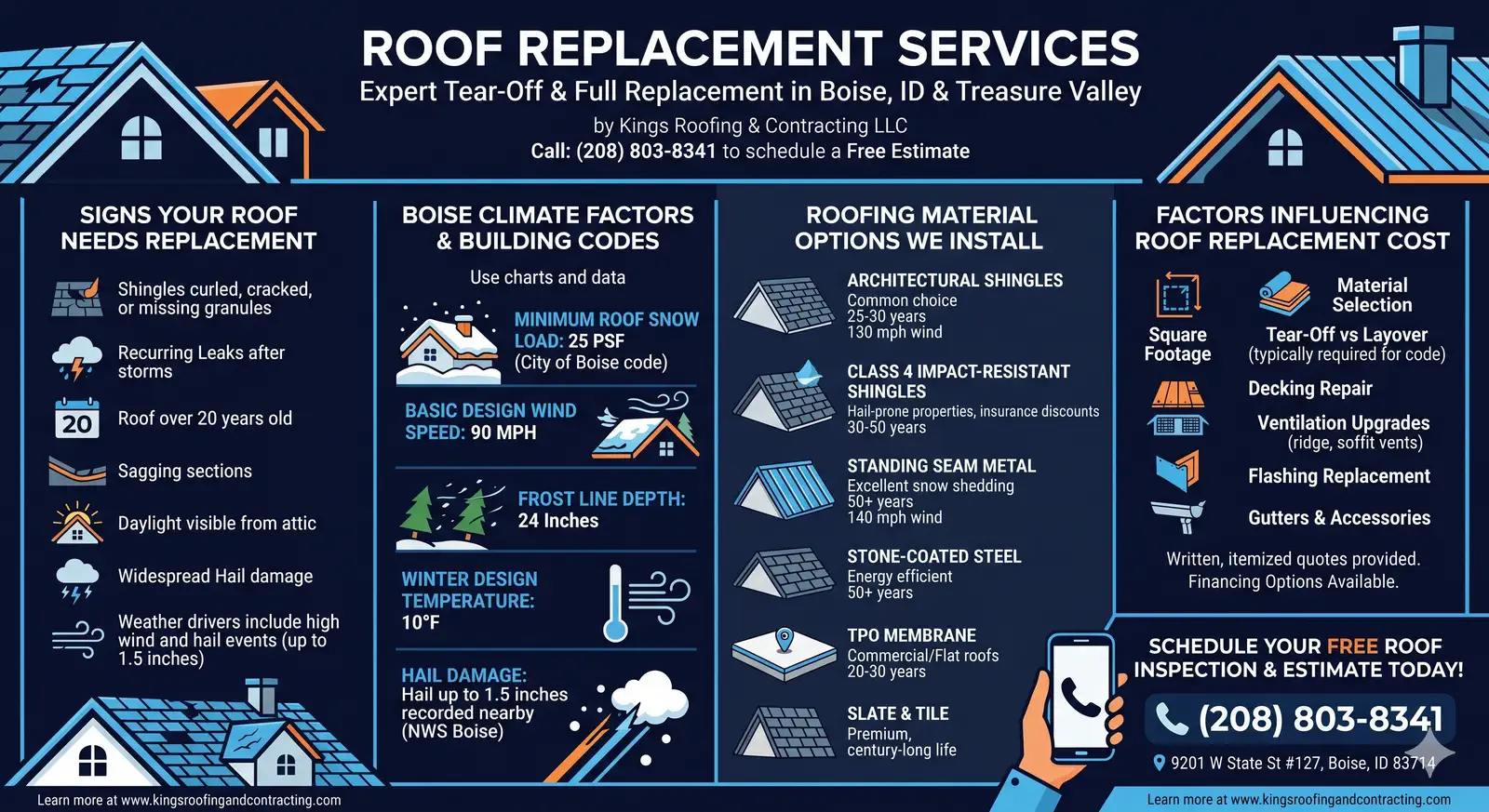
Getting a professional roof replacement estimate is the first step to protecting your home — and your budget. As a premier Boise roofing contractor, we want to make sure most Treasure Valley homeowners know what to expect upfront:

Quick Answer: What Does a Roof Replacement Cost in 2026?

Scenario Estimated Cost Range
1,500 sq ft home, asphalt shingles $7,000 – $12,000
2,000 sq ft home, asphalt shingles $8,500 – $15,000
2,000 sq ft home, standing seam metal $18,000 – $35,000
2,500 sq ft home, asphalt shingles $11,000 – $20,000
Idaho/Boise average (all materials) $9,114 (range: $5,115 – $16,740)

Costs vary based on roof pitch, complexity, material choice, tear-off layers, and local labor rates.

Replacing a roof is one of the largest investments a homeowner will make. The national average sits around $9,800 in 2026, but that number alone won’t tell you much — a steep pitch, rotted decking, or a premium material upgrade can push your final bill significantly higher or lower. For homeowners in Boise and the broader Treasure Valley, understanding what drives that number is the difference between a budget that holds and one that doesn’t.

At Kings Roofing & Contracting, we work with homeowners every day who are trying to make sense of competing bids, confusing line items, and vague online estimates. This guide breaks it all down clearly — materials, labor, pitch, hidden costs, and how to spot a bid that’s too good to be true.

I’m Ryan Santoro, owner of Kings Roofing & Contracting LLC, and with 24 years of construction experience I’ve helped hundreds of Treasure Valley homeowners work through the roof replacement estimate process — from first inspection to final installation. My goal here is to give you the same honest, no-pressure breakdown I’d give a neighbor.

Infographic showing key factors that affect a roof replacement estimate including size, pitch, material, labor, and location

Average Cost of a Roof Replacement in 2026

When planning a home improvement project, securing a precise roof replacement estimate is crucial to avoiding unexpected financial surprises. In 2026, the national average cost to replace a roof is $9,800, with most homeowners spending between $5,500 and $18,000 for architectural asphalt shingles. This reflects a steady 25.6% increase over the last four years, up from a national average of $7,800 in 2022. While inflation and supply chain shifts have driven up the raw cost of materials, the rate of increase has slowed down to a more manageable 2.1% year-over-year in 2026.

Understanding these baseline figures helps you evaluate whether the bids you receive from local contractors are fair, competitive, and realistic.

Baseline Figures for a Standard Home

To give you a clearer picture of how these averages apply to different property sizes, we have compiled standard pricing bands based on home square footage. That your home’s interior square footage is different from your roof’s actual surface area, which we will calculate in detail later.

Here is what you can expect to pay for a standard architectural asphalt shingle roof replacement based on the size of your home in 2026:

  • 1,500 Square Foot Home: Typically requires 17 to 19 squares of roofing material. The average cost ranges from $6,800 to $12,500.
  • 2,000 Square Foot Home: Typically requires 22 to 25 squares of roofing material. The average cost ranges from $8,800 to $17,500.
  • 2,500 Square Foot Home: Typically requires 27 to 30 squares of roofing material. The average cost ranges from $11,500 to $21,000.
  • 3,000 Square Foot Home: Typically requires 33 to 37 squares of roofing material. The average cost ranges from $14,000 to $26,000.

If you are looking to build a preliminary budget before speaking with a professional, you can use a high-quality Roof Replacement Cost Calculator 2026 — By Size & Material | CostPrism to establish your baseline cost bands.

Regional Price Variations and the Idaho Market

Where you live plays a massive role in your final estimate. For example, Hawaii is the most expensive state for a roof replacement, averaging $16,464 for a standard home, while Mississippi is the most affordable at an average of $7,840.

Here in the Mountain West and Southwest Idaho, we benefit from more stable regional labor rates. The average Idaho roof replacement cost is $9,114, with most projects falling within a healthy range of $5,115 to $16,740.

If you live in the Treasure Valley — whether that is Boise, Meridian, Nampa, Caldwell, Eagle, Garden City, or Kuna — you will find that local pricing is highly dependent on municipal permit fees and localized labor availability. For instance:

  • In Boise, the historical average for a standard replacement has hovered around $7,267, though the post-pandemic material spikes have pushed modern 2026 averages closer to the $9,000 mark. You can explore our dedicated Boise roof repair and replacement services to see how local weather and building permits affect these numbers.
  • Homeowners seeking services in surrounding communities like Garden City, Meridian, or Eagle will see slight variations in disposal fees and local city codes.
  • If you are budgeting for a project in Kuna, factoring in localized travel and regional delivery schedules is key to keeping your estimate accurate.

How Material Selection Shapes Your Roof Replacement Estimate

Your choice of roofing material is the single largest variable you can control. It drives roughly 30% to 40% of the total project cost and dictates how long your home will remain protected before needing another replacement.

To help you compare your options, we have compiled a direct breakdown of material costs per square foot and their expected lifespans:

Roofing Material Cost Per Square Foot (Installed) Expected Lifespan Warranty Range
Asphalt Shingles (3-Tab) $3.40 – $5.95 15 – 20 Years 20 – 25 Years
Architectural Shingles $4.11 – $5.57 25 – 30 Years 30 Years / Lifetime
Wood Shakes & Shingles $6.00 – $9.15 20 – 30 Years 20 – 30 Years
Clay & Concrete Tiles $6.30 – $12.30 50 – 100 Years 50 Years / Lifetime
Standing Seam Metal $18.11 – $24.50 50 – 70 Years 40 – 50 Years
Natural Slate $23.49 – $31.77 75 – 150 Years 75+ Years

How Material Lifespans Affect Your Roof Replacement Estimate

When evaluating a roof replacement estimate, it is easy to focus entirely on the upfront cost. However, savvy homeowners look at the annualized cost — how much the roof costs per year of its service life.

Consider a 20-year comparison between architectural asphalt shingles and standing seam metal roofing:

  • Architectural Asphalt Shingles: For a standard 2,000 square foot roof, an architectural shingle installation might cost around $9,800 upfront. With a 30-year warranty and a realistic 25-year service life in Idaho’s hot summers and freezing winters, the annualized cost is roughly $392 per year. You can read our detailed guide on shingle roof replacement costs to see how this material holds up.
  • Standing Seam Metal Roofing: The same roof installed with premium standing seam metal might cost $24,000 upfront. However, because metal roofs reflect solar radiation (reducing cooling costs by 10% to 25%) and last up to 70 years, the annualized cost over its lifespan drops to around $342 per year. Plus, a metal roof can increase your home’s resale value by up to 6%.

If you plan to stay in your home for 20 years or more, metal is often the superior financial investment. If you plan to sell within 7 to 10 years, architectural asphalt shingles offer the best return on investment because you recoup 61% to 67% of the cost upon resale.

Premium Materials: Slate, Tile, and Wood Shakes

For homeowners looking to make a dramatic architectural statement, premium materials offer unmatched beauty and extreme durability:

  • Natural Slate: Slate is the gold standard of roofing. It is completely fireproof and can last up to 150 years. However, at $23.49 to $31.77 per square foot, a full installation on a mid-sized home can range from $28,000 to over $50,000. Additionally, slate is incredibly heavy (800 to 1,500 pounds per square), often requiring structural rafter reinforcement.
  • Clay and Concrete Tiles: Extremely popular in Southwestern architecture, tile roofing costs between $6.30 and $12.30 per square foot. Clay tiles last 50 to 100 years, but they are brittle and must be professionally inspected periodically as they age to replace cracked pieces.
  • Wooden Shakes and Shingles: Cedar shakes offer a rustic, natural aesthetic, costing between $6.00 and $9.15 per square foot. A total replacement typically ranges from $10,230 to $15,500. While beautiful, they require regular maintenance to prevent rot, mold, and moss growth.

Key Cost Drivers: Size, Pitch, and Architectural Complexity

Many homeowners assume that a roof replacement is estimated solely by multiplying the home’s square footage by a flat material rate. In reality, professional estimators look at the physical geometry of your roof structure.

Diagram showing how roof pitch increases the actual roof surface area compared to the flat footprint

Understanding Roof Size and the Slope Correction Factor

In the roofing industry, materials and labor are calculated using “squares.” One roofing square is equal to 100 square feet of roof surface.

Your home’s footprint square footage does not equal your roof’s square footage. Because of the roof’s pitch (slope) and the overhang of the eaves, the actual surface area is always larger. To calculate the true area, we use a slope correction factor. For example:

  • A flat roof or low-slope roof (up to a 4/12 pitch) has a multiplier close to 1.0.
  • A standard 6/12 pitch roof has a correction factor of 1.118. A 2,000 square foot home footprint with a standard pitch actually requires roughly 24 squares (2,400 square feet) of roofing material once you account for the slope and a standard 2-foot eave overhang.
  • A steep 12/12 pitch roof (a 45-degree angle) has a correction factor of 1.414, meaning that same 2,000 square foot footprint requires over 28 squares of material.

To see how these geometric factors influence your specific property, you can experiment with The 40-Factor Roof Estimator & Calculator to see how pitch alters material requirements.

How Pitch and Complexity Impact a Roof Replacement Estimate

Pitch does more than just increase the physical surface area; it dramatically alters labor dynamics. A steeply sloped roof (defined as a 9/12 pitch or higher) requires specialized safety equipment, harness tie-offs, and roof jacks.

Because crew members must move slower and take extra safety precautions, a steep slope can add an extra $1,000 to $3,000 in labor surcharges compared to a low-slope roof.

Additionally, the complexity of your roof’s design plays a major role. A simple gable roof with two flat planes is highly efficient to install and has a low waste factor of around 10%. A complex roof with multiple hips, valleys, dormers, skylights, and chimneys requires extensive custom cutting. This increases the material waste factor to 15% or 20% and requires significantly more flashing and detailing labor.

Labor Rates and Essential Components Beyond Shingles

A high-quality roof is an engineered system, not just a layer of shingles. When you receive a comprehensive roof replacement estimate, it should include a detailed breakdown of labor and the vital structural components beneath the surface.

The Breakdown of Labor vs. Material Costs

Labor typically accounts for 60% of the total cost of a roof replacement. Professional roofers are highly skilled tradespeople working in a high-risk environment, which is reflected in their rates. Professional roofers generally charge around $40 to $90 per hour per worker, with master roofers earning about $130 per hour and general laborers earning about $35 per hour.

The remaining 40% of your estimate goes toward materials, disposal, permits, and overhead. To visualize how these costs are distributed across a standard project, you can review the Roof Replacement Cost Calculator (2026) to see typical line-item breakdowns.

Often-Forgotten Line Items in a Professional Estimate

When comparing bids, look closely to ensure the contractor hasn’t left out essential components to make their price look lower upfront. A complete, code-compliant roof system must include:

  • Tear-Off and Disposal: Removing and disposing of old shingles typically costs $0.40 to $2.00 per square foot (or $60 to $120 per square). If you have multiple layers of old shingles, expect an extra $1 to $2 per square foot in labor and heavy dumpster fees.
  • Roof Decking (Sheathing): This is the wooden foundation of your roof. Replacing or repairing water-damaged plywood or OSB decking costs between $2.20 and $3.00 per square foot (or $75 to $110 per 4×8 sheet installed).
  • Underlayment: This water-resistant barrier is installed directly over the wood deck. New underlayment is required by building codes and costs between $1.50 and $2.10 per square foot (adding $1 to $3 per square foot to the total job).
  • Ice and Water Barriers: Crucial for Idaho’s freezing winters, these self-adhering membranes prevent water from backing up under shingles due to ice dams. Replacing them costs $1.87 to $2.53 per square foot.
  • Flashing and Pipe Boots: Flashing prevents water from entering valleys, chimneys, and walls, costing $9.00 to $11.00 per linear foot. Replacing worn-out pipe boots around plumbing vents costs $63.00 to $85.00 each.
  • Fascia and Soffit Boards: If water has rotted your eaves, replacing fascia costs $4.25 to $8.62 per linear foot, while soffit replacement runs $2.80 to $5.28 per linear foot.
  • Permits: Local building permits are required for structural roofing work and can cost up to $500 depending on your municipality.

To see how these components are integrated seamlessly during a professional project, explore our guide to professional roof installation services.

Smart Strategies to Save Money on Your New Roof

While a roof replacement is a significant investment, there are several practical, professional ways to lower your out-of-pocket costs without sacrificing the structural integrity of your home.

Roofers installing energy-efficient shingles on a residential home

Timing Your Project for Maximum Savings

The roofing industry is highly seasonal. Late summer and fall are the busiest times of the year as homeowners rush to replace aging roofs before winter. Because demand is high, labor rates are firm and scheduling can be difficult.

You can often secure a 5% to 15% discount by scheduling your project during the “shoulder seasons” or the off-season (typically late winter or early spring, weather permitting). Contractors are often willing to lower their margins slightly during these months to keep their in-house crews working consistently.

Additionally, always obtain at least three written estimates. Comparing multiple bids “apples-to-apples” allows you to negotiate fairly and ensures you aren’t being overcharged. However, be wary of any bid that is significantly lower than the others — this is a major red flag that the contractor is cutting corners, skipping permits, or using subpar materials.

Repair vs. Replace: The 30% Rule of Thumb

Before committing to a full replacement, it is worth determining if a targeted repair is a more sensible option. Professional estimators generally use the “30% Rule of Thumb”:

  • When to Repair: If your roof is less than 15 years old, the damage is localized (e.g., a few shingles damaged by a windstorm or a minor leak around a single chimney), and the cost of the repair is less than 30% of the total replacement cost, a professional repair is highly recommended. You can learn more about our targeted Boise roof repair services to see how we extend the life of your existing system.
  • When to Replace: If your roof is over 20 years old, has widespread damage (such as bald shingles with heavy granule loss across multiple roof planes), or the cost of repairs exceeds 30% of a full replacement, investing in a new roof is the more financially sound long-term decision.

Frequently Asked Questions About Roof Replacement Estimates

How long does a typical residential roof replacement take?

For most standard single-family homes using asphalt shingles, the physical installation takes 1 to 3 days. If you choose premium materials like metal or tile, or if your roof has a highly complex design with multiple steep valleys, the project can take 3 to 7 days. Natural slate installations are the most labor-intensive and can take 1 to 3 weeks depending on the size of the home.

Does homeowners insurance cover the cost of a new roof?

Yes, but only if the damage is caused by a sudden, accidental covered event, such as a severe windstorm, fallen tree, or hail. Insurance policies typically exclude gradual wear and tear, neglect, or roofs that have simply reached the end of their natural lifespan.

When filing a claim, the payout depends on whether you have a Replacement Cost Value (RCV) policy, which covers the full cost of the replacement minus your deductible, or an Actual Cash Value (ACV) policy, which only pays the depreciated value of the roof based on its age. We recommend having a certified professional conduct a thorough roof inspection to document the damage with photos before you contact your insurance adjuster.

Can I install new shingles directly over my existing roof?

While most local building codes allow for up to two layers of asphalt shingles (known as a “nail-over” or overlay), we strongly advise against it. Installing new shingles over old ones saves you about $1,000 to $2,000 upfront in tear-off and disposal costs, but it carries severe long-term consequences:

  1. It prevents the contractor from inspecting the wooden decking underneath for hidden rot or structural water damage.
  2. It traps heat, which can shorten the lifespan of your new shingles by up to 50%.
  3. It can completely void the manufacturer’s material warranty.
  4. It adds massive extra weight to your home’s framing.

A complete tear-off down to the bare wood deck is always the best practice for a long-lasting, fully warrantied roof.

Conclusion

Securing an accurate roof replacement estimate doesn’t have to be a stressful or confusing process. By understanding your material options, calculating your roof’s true geometry, and accounting for essential underlayment and ventilation components, you can make a smart, highly informed decision that protects your home for decades to come.

At Kings Roofing & Contracting, LLC, we pride ourselves on delivering transparent, line-by-line pricing with absolutely zero sales pressure. As a GAF-certified contractor serving Boise, Meridian, Nampa, Caldwell, Eagle, Garden City, and Kuna, we back our workmanship with industry-leading warranties and are available 24/7 to support our community.

Ready to get a real, highly accurate number for your home? Explore our services or request a personalized free roof quote today. We also offer flexible financing options to help make your project as affordable as possible.

You can also reach out to us directly to speak with a local roofing expert today!

Latest Articles & News