3-Tab vs. Architectural Shingles: Which Is Right for Your Roof?
If you’re weighing roofing options, here’s the quick answer:
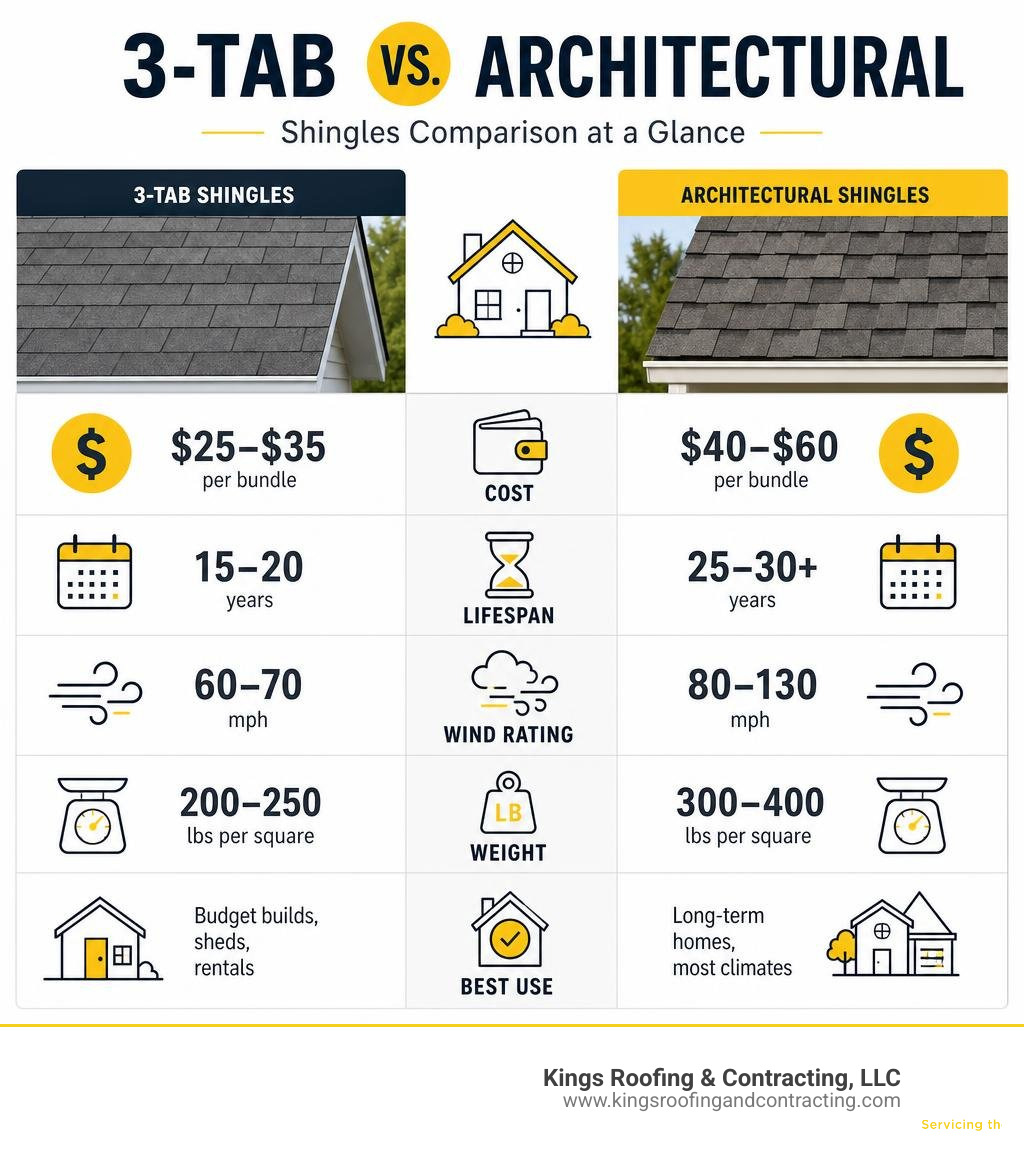
| Feature | 3-Tab Shingles | Architectural Shingles |
|---|---|---|
| Cost per bundle | $25–$35 | $40–$60 |
| Lifespan | 15–20 years | 25–30+ years |
| Wind resistance | 60–70 mph | 80–130 mph |
| Weight per square | 200–250 lbs | 300–400 lbs |
| Best for | Budget builds, sheds, rentals | Long-term homes, most climates |
A 3 tab shingle is one of the most affordable roofing options available — and one of the most misunderstood. Some homeowners dismiss it as outdated. Others swear by it for budget builds and rental properties. The truth is more nuanced.
Both 3-tab and architectural shingles are made from asphalt. Both protect your home from rain, snow, and UV damage. But they differ significantly in thickness, durability, wind resistance, and long-term cost.
For Treasure Valley homeowners dealing with professional roof replacement in Boise, choosing the wrong shingle type can mean paying twice — once for the roof, and again for early repairs or replacement.
This guide breaks down exactly how these two shingle types compare, so you can make a confident, informed decision before spending a dollar.
I’m Ryan Santoro, owner of Kings Roofing & Contracting LLC, with 24 years of construction experience across residential and commercial roofing systems — including hundreds of 3 tab shingle installations and replacements across the Treasure Valley. That hands-on experience shapes everything in this guide, from real-world cost expectations to the installation details most homeowners never hear about.
What is a 3 Tab Shingle and How is it Constructed?
A 3 tab shingle—often referred to in the industry as a strip shingle—is a single-layer asphalt roofing product designed with three uniform tabs cut along the bottom edge. When installed, these cutouts give the illusion of three separate, smaller shingles laid side by side, creating a clean, flat, and highly symmetrical pattern across your roof deck.
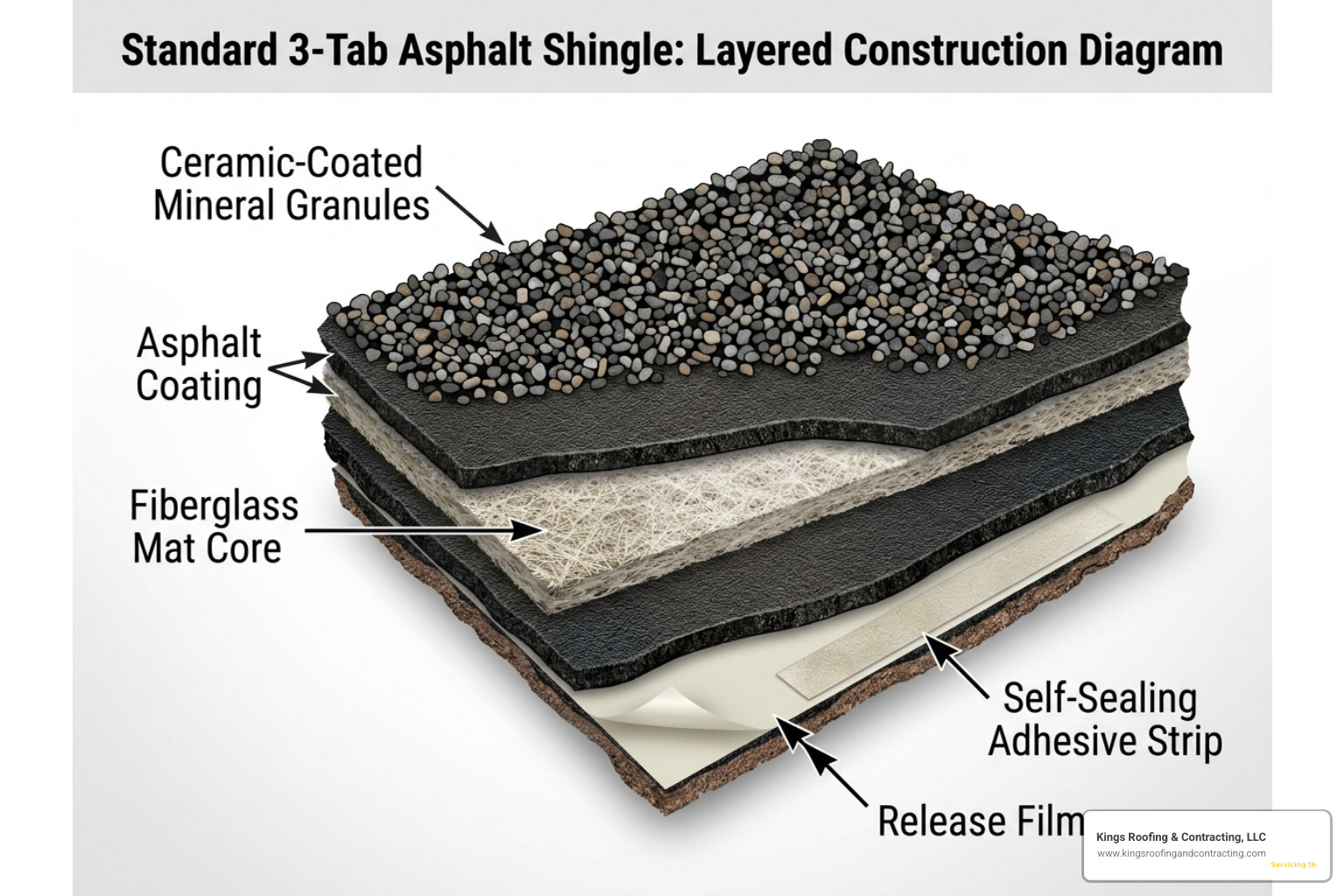
To understand how a 3 tab shingle is constructed, we have to look beneath its outer surface. The manufacturing process relies on a multi-layered design engineered to balance low-cost production with baseline weather protection:
- The Fiberglass Mat: The structural backbone of the shingle is a thin, flexible mat woven from glass fibers. This core provides the tensile strength required to resist tearing during installation and seasonal temperature swings.
- Weathering-Grade Asphalt: The fiberglass mat is thoroughly saturated and coated on both sides with a heavy layer of oxidized asphalt. This asphalt acts as the primary waterproofing barrier, keeping moisture from penetrating your home.
- Ceramic-Coated Mineral Granules: Embedded into the top layer of hot asphalt are crushed stone granules. These granules are ceramic-coated for color stability and serve two critical protective functions: they shield the underlying asphalt from degrading UV rays and provide essential Class A fire resistance.
- The Self-Sealing Adhesive Strip: On the back of each shingle is a factory-applied strip of thermoplastic adhesive. When exposed to solar heat after installation, this strip activates and bonds the overlapping shingles together to resist wind uplift.
This classic design has a long history. First introduced in 1935 as a mass-produced alternative to individual wood or slate tiles, the 3 tab shingle quickly became the dominant residential roofing material in North America by the 1970s. Its flat, uniform aesthetic defined suburban neighborhoods for decades.
While modern building trends have shifted toward thicker materials, 3-tab strips remain a staple of the industry. If you want to explore how they fit into the broader landscape of residential products, you can read our complete breakdown of the various Types of Roofing available today.
3-Tab vs. Architectural Shingles: The Core Differences
While both products belong to the asphalt family, comparing a 3 tab shingle to an architectural (or dimensional) shingle is like comparing a flat sheet of plywood to a hand-carved wooden panel. The core difference lies in their physical depth, weight, and structural composition.
Architectural shingles are laminated, meaning they consist of two or more asphalt layers bonded together. This multi-layer construction eliminates the uniform tab cutouts of a standard strip shingle, replacing them with staggered, dimensional tabs that mimic the rustic texture of natural wood shakes or slate tiles.
The physical contrast is stark:
- Thickness and Weight: Architectural shingles are roughly 40% to 50% thicker than 3-tab options. This extra material translates to a much heavier product, with architectural shingles weighing 300 to 400 lbs per square (100 square feet) compared to the lightweight 200 to 250 lbs per square of a 3 tab shingle.
- Visual Curb Appeal: Because your roof can make up 30% to 40% of what people see from the street, aesthetics matter. A 3-tab roof offers a smooth, repetitive, and flat look. Architectural shingles offer deep shadow lines and a rich, textured surface that can elevate your home’s exterior design and even add a 5% to 10% premium to your home’s resale value.
If you are trying to decide which style best matches your budget and architectural goals, our dedicated guide to Asphalt Shingle Roofing dives deeper into these stylistic differences.
Lifespan and Durability of the 3 Tab Shingle
A standard 3 tab shingle roof has a realistic lifespan of 15 to 20 years in mild climates. However, this longevity drops significantly to just 10 to 12 years in regions exposed to severe weather, high winds, or extreme temperature swings.
Because 3-tab shingles are thin and consist of a single layer, they are highly vulnerable to thermal shock—the rapid expansion and contraction caused by hot summer afternoons followed by chilly desert nights. Over time, this constant movement causes the single asphalt layer to dry out, crack, and shed its protective granules. Once the granules wash away, the underlying asphalt is exposed to direct sunlight, accelerating the decay process.
By comparison, architectural shingles easily last 25 to 30+ years, with premium lines rated for 40 to 50 years under ideal conditions. The thick, laminated layers of architectural shingles insulate the roof deck far better and resist the warping, curling, and splitting that often plagues older 3-tab installations.
If you are shopping for replacement materials online, you can check out current retail options and warranty terms on the 3-Tab Roof Shingles for Residential Roofing | Lowe’s product page to see how manufacturers structure their basic lines.
Wind and Weather Resistance of the 3 Tab Shingle
The flat, lightweight profile of a 3 tab shingle makes it highly susceptible to wind damage. Most standard 3-tab shingles carry a wind resistance rating of only 60 to 70 mph. When high winds sweep across a roof, they can easily get underneath the thin, exposed tabs, breaking the thermal sealant bond and peeling the shingles backward.

Architectural shingles, on the other hand, routinely achieve wind ratings of 110 to 130 mph, with some premium systems rated up to 150 mph. Their heavy weight and lack of physical cutouts mean there are no loose tabs for the wind to catch.
For technical proof of how these materials hold up under testing, look at the TAMKO Elite Glass-Seal Data Sheet.pdf). While these shingles meet standard industry requirements—such as a UL Class A Fire Rating, UL Class H Wind Resistance (ASTM D7158), and Class F (ASTM D3161)—they are physically limited by their single-layer construction.
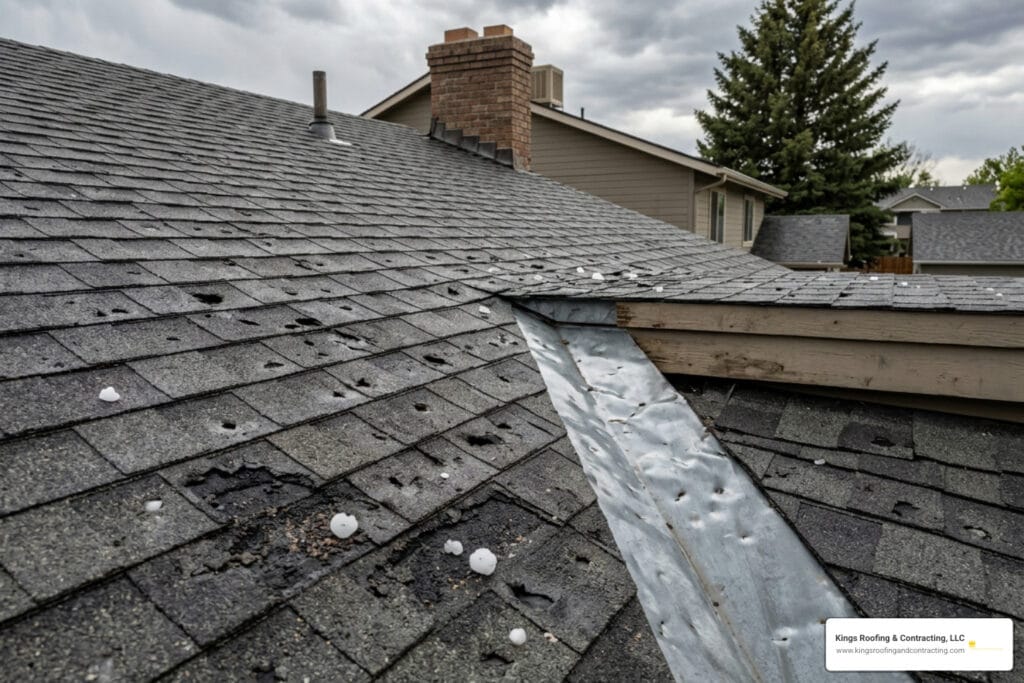
In areas prone to heavy snow, hail, or severe seasonal storms, a 3-tab roof will require far more frequent repairs than a heavier, multi-layered dimensional roof.
Cost Analysis: Upfront Savings vs. Long-Term Value
When evaluating a 3 tab shingle, the primary draw is always the upfront price. It is indisputably the most budget-friendly asphalt option on the market.
To put this in perspective, let’s look at the material and long-term financial numbers:
- Material Cost: 3-tab shingles typically cost $25 to $35 per bundle. Architectural shingles range from $40 to $60 per bundle. Since it takes three bundles to cover one square (100 square feet) of roof space, you save roughly $45 to $75 in raw materials per square by choosing 3-tab.
- Total Installed Cost: For a standard 2,000-square-foot roof, a professional 3-tab installation generally ranges from $1.00 to $2.50 per square foot. Upgrading to architectural shingles pushes that range to $1.50 to $4.00 per square foot.
While saving thousands of dollars upfront is highly appealing, the long-term cost of ownership tells a different story.
Consider a 30-year timeline. If you install a 3 tab shingle roof, you will likely have to replace it twice over those 30 years due to its shorter 15-year lifespan. You will also pay for multiple spot repairs to fix wind-damaged tabs along the way. If you install a high-quality architectural roof, that single installation will easily last the entire 30 years, saving you a massive amount of money on a second tear-off and labor charge down the road.
Upfront savings are great, but durability represents the true long-term value.
Best Use Cases for 3-Tab Shingles in 2026
Despite the superior durability of architectural shingles, the 3 tab shingle remains an incredibly useful product for specific, targeted applications in 2026. It is not a “bad” product; it is simply a specialized tool for specific scenarios.
The best use cases for 3-tab shingles include:
- Sheds, Detached Garages, and Outbuildings: If you are roofing a simple backyard tool shed, a chicken coop, or a detached utility garage, spending extra money on premium architectural shingles is rarely necessary. A budget-friendly 3-tab product provides excellent, cost-effective weatherproofing for non-living spaces.
- Rental and Investment Properties: If you own a rental property and operate on a tight cash-flow budget—or plan to renovate and sell the property within a 5-to-7-year window—the low upfront cost of a 3-tab roof helps keep capital expenditures low.
- Strict Budget Restraints: When a roof is actively leaking and must be replaced immediately to protect the home’s structure, but funds are limited, 3-tab shingles offer a safe, code-compliant, and fully waterproof solution that fits a modest budget.
- Local HOA and Historical Requirements: Some older subdivisions and historic districts in the Treasure Valley have strict design codes requiring a completely flat, uniform roof profile to maintain historical accuracy. In these rare cases, architectural shingles may actually be banned, making 3-tab the only approved choice.
If you are located in southwest Idaho and need to know if 3-tab shingles are appropriate for your specific neighborhood or structure, our local team can help you navigate local building codes and performance expectations with a professional boise roof repair or replacement consultation.
Professional Installation and Maintenance Best Practices
A roof is only as good as the quality of its installation. Because 3-tab shingles are thin and lightweight, minor installation errors that might go unnoticed on a thick architectural roof will quickly lead to blow-offs, buckling, and leaks on a 3-tab system.
To ensure a leak-free installation, professional roofers must follow strict technical guidelines:
- Deck Preparation: The roof deck must be completely smooth, dry, and free of rot. Any warped boards or delaminated plywood must be replaced. We recommend a minimum of 3/8-inch plywood or 25/32-inch wood sheathing.
- Underlayment: A high-quality synthetic underlayment or heavy-duty felt must be laid down first, along with an ice and water shield along the eaves to protect against winter ice dams.
- The Starter Course: A proper starter strip must be installed along the eaves to provide a secure fastening point and prevent wind from lifting the first course of shingles.
- The 6-Inch Offset: Shingles must be laid using a precise 6-inch offset (or 6-9/16 inches for metric-sized shingles) as they go up the roof. This staggers the vertical joints between tabs, ensuring water cannot find a direct path to the wood deck below.
- Nailing Pattern: Standard installations require four galvanized roofing nails per shingle, driven flush (never angled) exactly 5/8-inch above the tab cutouts and below the sealant strip. In high-wind areas or on steep slopes, six nails and hand-applied roofing cement are required.
For a complete step-by-step technical breakdown of these measurements, you can refer directly to the official Owens Corning Three-Tab Shingles Installation Instructions.
If you want to ensure your project is completed to these exact manufacturer standards, our factory-certified crews at Kings Roofing & Contracting can handle the entire process. Learn more about our high-standards approach on our Roof Installation service page.
Essential Maintenance to Prevent Leaks
Because 3-tab shingles are highly susceptible to wind uplift and rapid granule loss, establishing a consistent maintenance routine is essential to maximizing their service life.
We recommend scheduling a professional roof inspection at least once a year. During this inspection, look for:
- Granule Accumulation: Check your gutters for heavy piles of mineral granules. High granule loss is a clear indicator that the shingles are reaching the end of their functional life.
- Curling or Clawing Edges: If the corners of the tabs are curling upward (clawing) or shrinking, water can easily blow underneath them during rainstorms.
- Moss and Algae Growth: Moss acts like a sponge, holding moisture against the shingle surface and rotting the asphalt. Safely remove moss using gentle, eco-friendly chemical washes—never pressure wash an asphalt roof, as the high pressure will instantly strip away the protective granules.
Taking these small steps will keep your roof in peak condition. For more tips on protecting your investment, explore our comprehensive guide to Roof Maintenance.
When to Choose Repair vs. Full Replacement
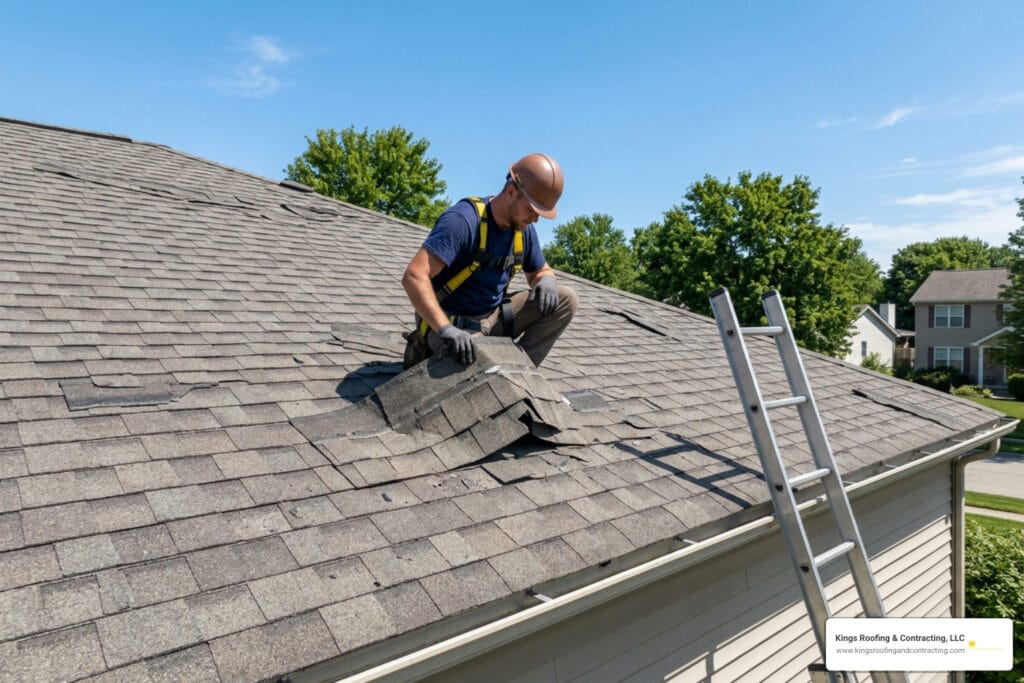
If you wake up after a windy night and find a couple of shingle tabs lying in your yard, you don’t necessarily need to panic and buy an entirely new roof.
Spot repairs are highly effective if:
- The damage is isolated to a small area (e.g., only a few tabs were torn off by a fallen tree limb).
- The rest of the shingles are still flexible, hold their granules well, and are less than 10 to 12 years old.
- You can find a close color match to blend the patch into the existing roof.
However, a full replacement is required if:
- The shingles are brittle and crack easily when bent. This indicates the asphalt has dried out, and any attempt to nail down new patch shingles will simply shatter the surrounding old ones.
- You are experiencing recurring leaks in multiple areas of the home.
- The roof is over 15 years old and shows widespread curling, cracking, and severe granule loss.
If you are dealing with storm damage or general wear, our team can provide an honest assessment of your roof’s condition. Visit our Roof Repair page to learn how we approach targeted fixes versus full replacements.
Top Manufacturers and Availability in 2026
If you decide that a 3 tab shingle is the right choice for your project, it is important to buy from trusted, industry-leading manufacturers. The top three brands producing reliable 3-tab lines in 2026 include:
- GAF (Royal Sovereign Series): As North America’s largest roofing manufacturer, GAF’s Royal Sovereign line is the gold standard for 3-tab performance. It features advanced color-blending technology and a highly reliable micro-weave core. You can view their full color lineup on the official GAF 3-Tab Shingles Collection page.
- Owens Corning (Supreme Series): Known for outstanding physical strength, the Supreme series offers a clean look and a Class A fire rating. To see specifications and color blends like Driftwood or Onyx Black, check out the Owens Corning Supreme Shingles product catalog.
- CertainTeed (XT 25 Series): Built on a super-tough fiberglass base, the XT 25 is widely regarded as one of the heaviest and most durable strip shingles in its class.
A Warning on Color Matching in 2026: Because 70% to 80% of the residential market has upgraded to architectural shingles, manufacturers have significantly reduced the color options and production runs for 3-tab shingles. If you need to perform a spot repair on an older 3-tab roof, finding an exact color match can be incredibly difficult. We always recommend keeping a spare bundle of shingles in your garage or shed after a new installation to make future repairs seamless.
Frequently Asked Questions About 3-Tab Shingles
Are 3-tab shingles still manufactured and available?
Yes, major manufacturers like GAF, Owens Corning, and CertainTeed still actively produce 3-tab shingles. However, their market share has shrunk dramatically as architectural shingles have become the modern residential standard.
While still widely available at major home improvement outlets and through professional distributors, you will find fewer color options on the shelves than in previous decades. For a deeper look at how these market changes affect homeowners in southwest Idaho, read our localized guide, No More Leaks: The Ultimate Guide to Asphalt Shingles in Boise.
Can you mix 3-tab and architectural shingles on the same roof?
No, you should never mix 3-tab and architectural shingles on the same roof slope. Because architectural shingles are significantly thicker, mixing them creates an uneven, staggered surface that prevents the self-sealing adhesive strips from bonding properly. This compromises the roof’s wind resistance and creates direct pathways for water to leak through. Additionally, the visual contrast between flat 3-tab strips and textured architectural shingles looks highly mismatched and hurts your home’s curb appeal.
Do architectural shingles require a stronger roof structure?
No, the vast majority of modern homes built with standard rafters or trusses can easily support the added weight of architectural shingles. While architectural shingles are 40% to 50% heavier than 3-tab shingles (weighing 300 to 400 lbs per square versus 200 to 250 lbs), this weight is easily distributed across a standard roof structure.
However, if you own an older historic home with structural framing issues, sagging rafters, or multiple existing layers of old roofing, you should have a professional inspection completed before upgrading to a heavier material.
Conclusion
When it comes to the great shingle showdown, there is no single “correct” answer. The best choice depends entirely on your budget, your long-term goals, and the structure you are covering:
- If you are roofing a shed, managing a short-term rental property, or working with a tight upfront budget, a high-quality 3 tab shingle is a practical, reliable, and highly cost-effective solution.
- If you are protecting your forever home, want to maximize wind resistance against severe weather, or want to elevate your home’s curb appeal and resale value, upgrading to architectural shingles is always the smarter long-term investment.
At Kings Roofing & Contracting, LLC, we believe in providing honest advice and transparent pricing. As a GAF-certified contractor serving Boise, Meridian, Nampa, Caldwell, Eagle, Kuna, and the surrounding Treasure Valley, we are committed to installing high-quality roofs that stand the test of time. Whether you need a quick repair, a budget-friendly 3-tab installation, or a premium architectural upgrade, we are here for you with 24/7 emergency services and expert workmanship.
Don’t leave your home’s protection to chance. Schedule a Free Roof Inspection with our local team today to discuss your project!