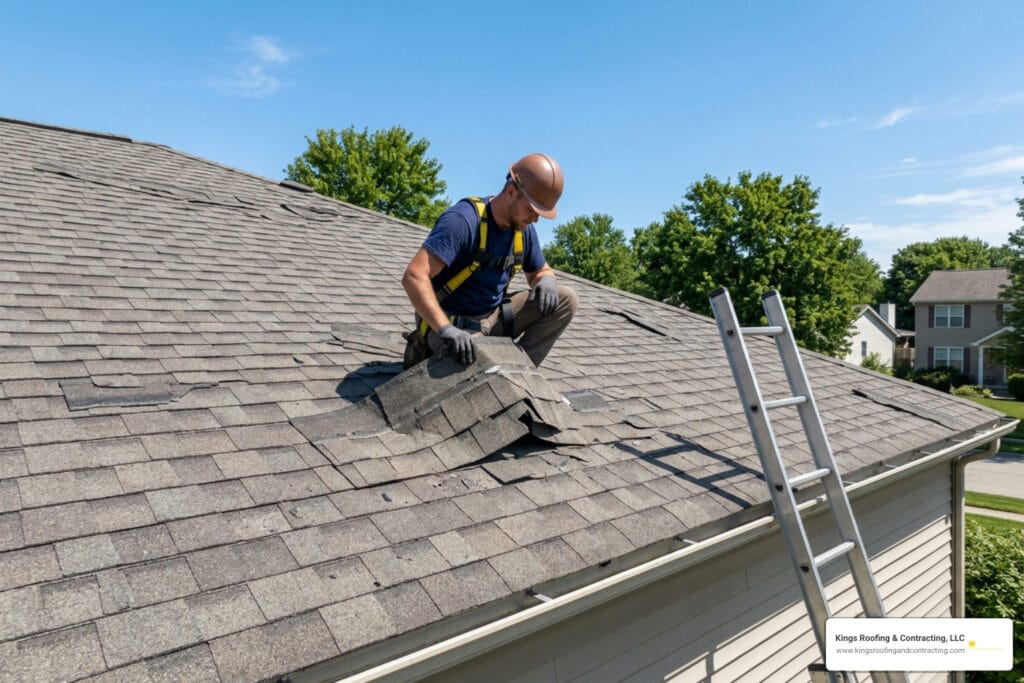
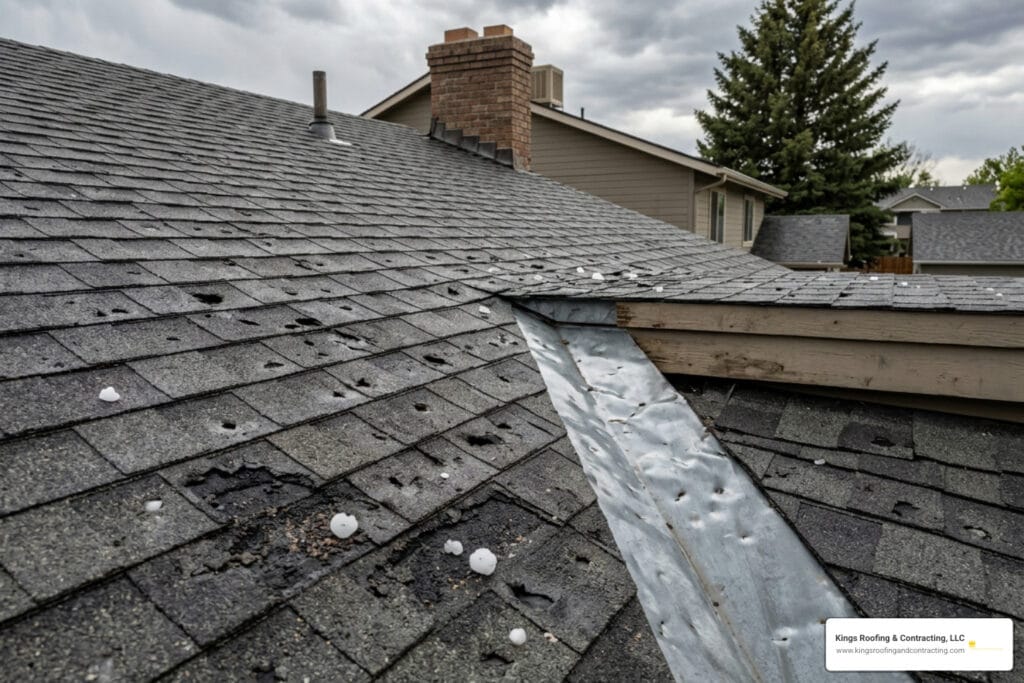
Assess Hail Damage to Your Idaho Roof Before Costs Grow
After a hailstorm, assess hail damage roof Idaho homes by photographing damage from the ground, checking gutters and metal fixtures for dents, and scheduling a professional inspection before filing an insurance claim. Do not climb onto a wet or damaged roof. Hidden shingle bruises can lose protective granules and worsen under Treasure Valley sun, winter snow load, and freeze-thaw conditions.
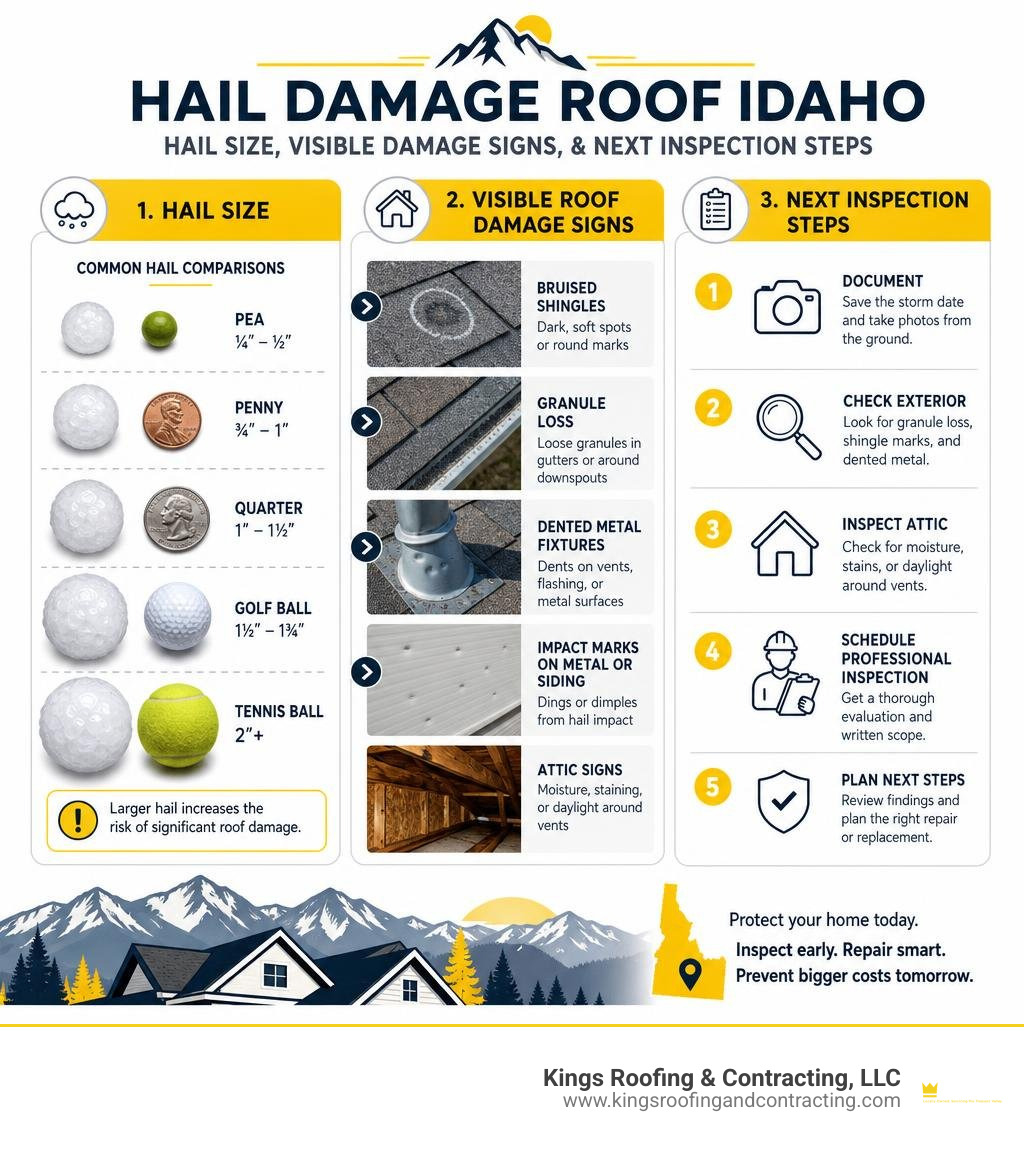
Start with these steps:
- Save the storm date and take photos of hailstones, dented gutters, downspouts, vents, siding, and air-conditioner fins.
- Look for loose granules at downspouts and dark, round marks on visible shingles.
- Check the attic for fresh moisture, staining, or daylight around vents.
- Get a written inspection and repair scope from a Boise roofing contractor before agreeing to repairs.
Boise-area roofs face more than hail. High-desert UV, wide temperature swings, spring wind, ice dams, and snow loads can turn small impact damage into leaks. Reroofing work may also require permits under Ada County or local jurisdiction rules, so confirm requirements before work begins.
I am Ryan Santoro, owner of Kings Roofing & Contracting, LLC, with 24 years of construction and roofing experience in the Treasure Valley. I help homeowners evaluate hail damage roof Idaho concerns with clear documentation, practical repair options, and an honest scope of work.
Hail damage roof idaho terms explained:
Identifying Hail Damage Roof Idaho Risks and Weather Patterns
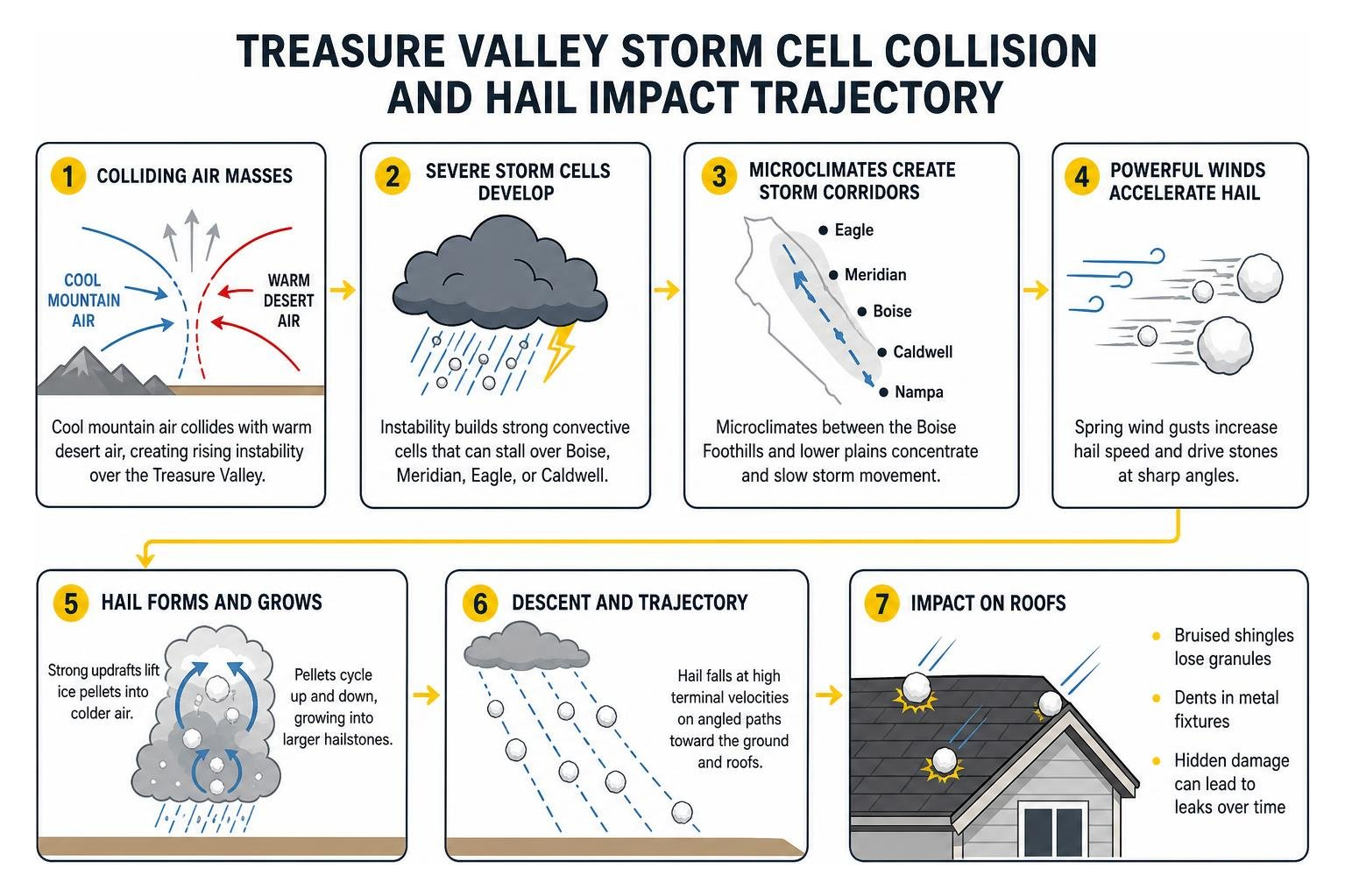
Hailstorms in the Treasure Valley develop rapidly when cool mountain air masses collide with rising thermal currents from the desert floor. When these unstable systems stall over Boise, Meridian, Eagle, or Caldwell, they produce severe convective cells capable of dropping hail ranging from pea-sized stones to golf-ball-sized projectiles traveling at high terminal velocities.
Our compiled tracking of regional weather events shows that localized microclimates between the Boise Foothills and the lower plains of Nampa create distinct storm corridors. Powerful spring wind gusts accelerate these descending ice spheres, driving them at sharp angles against roof slopes. Local news outlets regularly report how quickly Treasure Valley dumped with torrential rain, severe winds, and hail can compromise residential building envelopes in minutes.
Treasure Valley Climate Factors and Severe Spring Storms
The high-desert climate of Southwest Idaho imposes intense physical demands on exterior building materials. Following a severe convective storm, the roof does not merely recover; it enters an accelerated cycle of thermal degradation.
- High-Desert UV Exposure: Intense solar radiation bakes asphalt shingles, evaporating essential volatile oils and leaving the asphalt substrate brittle.
- Rapid Temperature Swings: Diurnal shifts exceeding 40 degrees Fahrenheit cause rapid expansion and contraction across roof decking and flashings.
- Freeze-Thaw Cycles: Water from melted hail seeps into microscopic fractures, expanding as temperatures drop below freezing at night.
- Winter Snow Load and Ice Dams: Weakened, bruised areas on a roof cannot support heavy winter snowpack, leading to ice dam intrusion along the eaves.
Reviewing a visual breakdown for identifying roof hail impact signs helps homeowners recognize how subtle surface pitting rapidly evolves into active roof leaks under these harsh conditions.
How NASA Satellite Data Helps Track Hail Damage Roof Idaho Events
Atmospheric scientists and meteorologists rely on data accessible through platforms like the NASA Technical Reports Server (NTRS) and Earth-observing satellite networks to study hail formation dynamics. NASA’s Global Precipitation Measurement (GPM) constellation and NEXRAD dual-polarization radar research allow specialists to map storm swaths with extreme accuracy.
By measuring radar reflectivity (Z) and differential reflectivity (ZDR), satellite algorithms identify the precise altitude of the freezing layer and calculate hail kinetic energy before stones hit the ground. For property owners, these scientific datasets provide definitive proof of storm severity and swath boundaries during specific dates of loss, eliminating guesswork when establishing insurance claim validity.
Evaluating Material Vulnerability from Hail Impact and High-Desert Weather

Every roofing material responds differently to dynamic impact loads. When hail strikes a roof, it compresses the outer surface, transmits shockwaves through the substrate, and challenges the underlying structural decking.
| Roofing Material | Primary Hail Vulnerability | High-Desert Weather Risk | Impact Resistance Rating | Expected Lifespan Post-Impact |
|---|---|---|---|---|
| Standard 3-Tab Asphalt | Granule displacement, fiberglass mat fracturing | Accelerated UV drying, wind tear-off | Class 1 to Class 2 | 1–3 years if untreated |
| Architectural Asphalt | Localized bruising, edge delamination | Granule loss exposing asphalt core | Class 3 to Class 4 | 5–10 years if bruising is minor |
| Standing Seam Metal | Cosmetic denting, seam displacement | Fastener expansion, thermal buckling | Class 4 | 30+ years (retains structural integrity) |
| Concrete & Clay Tile | Edge chipping, transverse cracking | Freeze-thaw spalling, ice dam leaks | Class 3 to Class 4 | 20+ years (broken tiles require replacement) |
Impact on Asphalt Shingles, Metal, and Tile Systems
Asphalt shingles are the most widely installed material across Ada and Canyon counties, yet they remain highly susceptible to dynamic impact. When hail dislodges mineral granules, the exposed asphalt core deteriorates rapidly under high-desert UV rays.
Metal systems, particularly standing seam panels, offer superior Class 4 impact resistance. While large stones leave aesthetic indentations, heavy-gauge steel prevents puncture and structural water penetration. Concrete tile resists surface abrasion well, but direct impacts near unsupported interlocking corners often cause hidden fractures. Homeowners facing extensive storm damage can review modern roof replacement options in Idaho to determine which resilient materials best suit their architecture and budget.
NASA NTRS Research on Impact Velocity and Structural Integrity
NASA-funded aerodynamic and terminal velocity research published on the NTRS details the physics of high-velocity ice sphere impacts. The kinetic energy ($E_k$) transferred to a residential roof during a storm is governed by the standard kinetic energy formula:
$$E_k = \frac{1}{2}mv^2$$
Where:
- $m$ is the mass of the hailstone (proportional to its volume and density).
- $v$ is the terminal velocity, heavily increased by downdraft wind speeds.
A 1.75-inch hailstone falls at roughly 40 to 50 miles per hour in calm conditions. When combined with 50 mph spring wind gusts in Boise, the impact velocity vectors increase dramatically, delivering dynamic loads exceeding 20 foot-pounds of kinetic energy per strike. This energy shatters the brittle fiberglass scrim inside standard asphalt shingles, compromising the material’s waterproofing capabilities.
How to Assess and Document Roof Damage for Insurance Claims
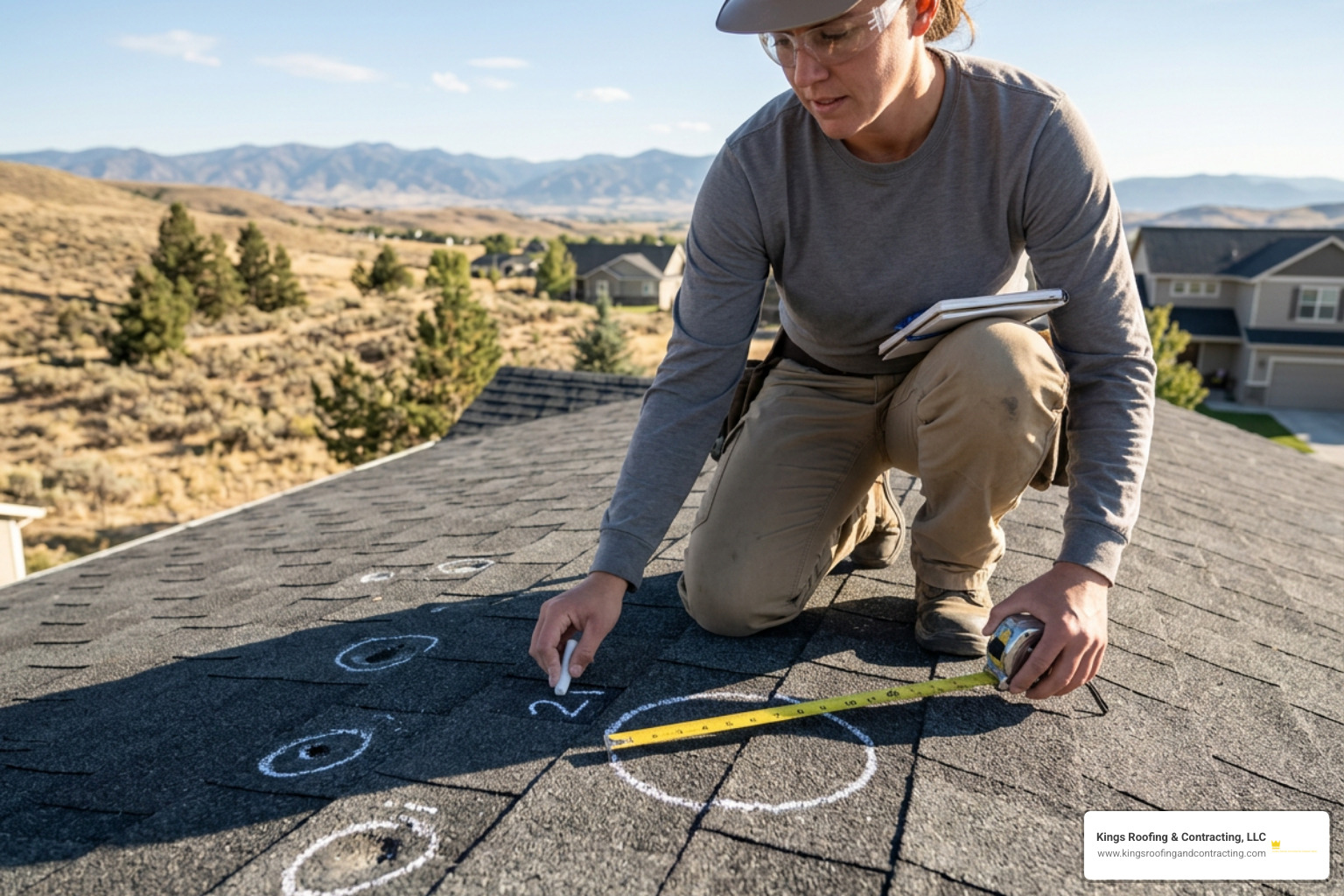
Properly documenting hail impact requires a systematic approach. Insurance carriers require clear physical evidence connecting property damage to a specific storm date within the policy limitation window.
Homeowners should review policy specifics, including deductible structures and winter weather damage coverage considerations, to ensure smooth claims processing before secondary water intrusion occurs.
Step-by-Step Inspection Checklist for Hail Damage Roof Idaho Homes
A professional hail assessment follows a methodical progression across the entire exterior envelope:
- Soft Metal Collateral Check: Inspect aluminum gutters, downspouts, roof vents, and valley flashing for distinct circular indentations.
- Perimeter HVAC and Siding Review: Check painted exterior siding for chipped paint and examine thin aluminum air conditioner condenser fins for crushing.
- Test Square Layout: On the roof surface, mark a 10-foot by 10-foot test square on each directional slope to count direct impacts.
- Shingle Bruise Identification: Gently press suspected impact marks to verify if the underlying fiberglass mat has fractured beneath intact granules.
- Attic Envelope Inspection: Check rafters and roof sheathing for moisture discoloration, ring-shank nail corrosion, or daylight penetrations.
Filing Ada County Permits and Working with Adjusters
Reroofing and structural repairs in Boise, Meridian, Eagle, and unincorporated Ada County require formal building permits under local building codes. When negotiating scopes of work with insurance adjusters, roofing contractors must ensure that mandatory code upgrades—such as ice and water shield installation along eaves, adequate intake-to-exhaust ventilation ratios, and drip edge flashing—are explicitly covered in the claim summary.
We meet directly with insurance adjusters on-site to walk the roof slopes, review test square findings, and verify that all necessary structural allowances conform to municipal codes.
Estimated Costs for Boise Roof Repairs and Replacement
Repair and replacement costs in the Treasure Valley depend on roof pitch, accessibility, architectural complexity, and material selection. Standard asphalt shingle repairs for minor localized hail strikes range from $450 to $1,800.
When hail density exceeds 8 to 10 strikes per 100-square-foot test square across multiple slopes, insurance standards generally dictate a full replacement. Complete residential roof replacements in Boise typically cost between $8,500 and $22,000 for standard asphalt shingles, while premium standing seam metal or tile configurations range from $18,000 to $38,000. Exploring storm damage restoration services ensures your home receives high-performance materials rated to withstand future severe weather.
Frequently Asked Questions About Hail Damage in Idaho
How do I know if hail damaged my roof without climbing up?
You can confirm hail damage from ground level by checking soft metals and perimeter fixtures. Inspect your downspouts, metal mailbox, vinyl window wraps, window screens, and the aluminum fins on your exterior air conditioning unit for dents. If your gutters show heavy accumulations of dislodged mineral granules after a storm, your roof has sustained impact.
How long do I have to file a hail damage roof insurance claim in Idaho?
Most standard homeowners insurance policies in Idaho enforce a strict 12-month filing window from the verified date of loss. Some policies limit this window to 6 months. Filing as soon as possible prevents insurance carriers from denying coverage based on subsequent weathering, UV deterioration, or normal wear and tear.
Can minor hail bruising cause long-term leaks in Boise roofs?
Minor shingle bruising frequently leads to chronic roof leaks. Hail strikes break the internal fiberglass matting without leaving an immediate hole. As Boise’s high-desert sun bakes the shingle and winter freeze-thaw cycles expand trapped water, the bruised area delaminates, allowing moisture to penetrate the decking and cause structural rot.
Conclusion
Hail damage across the Treasure Valley requires immediate, professional attention before high-desert UV rays and winter snow loads turn minor surface bruises into costly interior leaks. Kings Roofing & Contracting, LLC provides GAF-certified storm restoration, transparent pricing, and comprehensive claims documentation throughout Boise, Meridian, Nampa, Caldwell, and Eagle.
Contact our team to schedule a roof assessment with our Boise specialists to protect your home’s structural integrity.