Clay vs. Concrete Tiles: Which Is the Better Roof for Your Home?
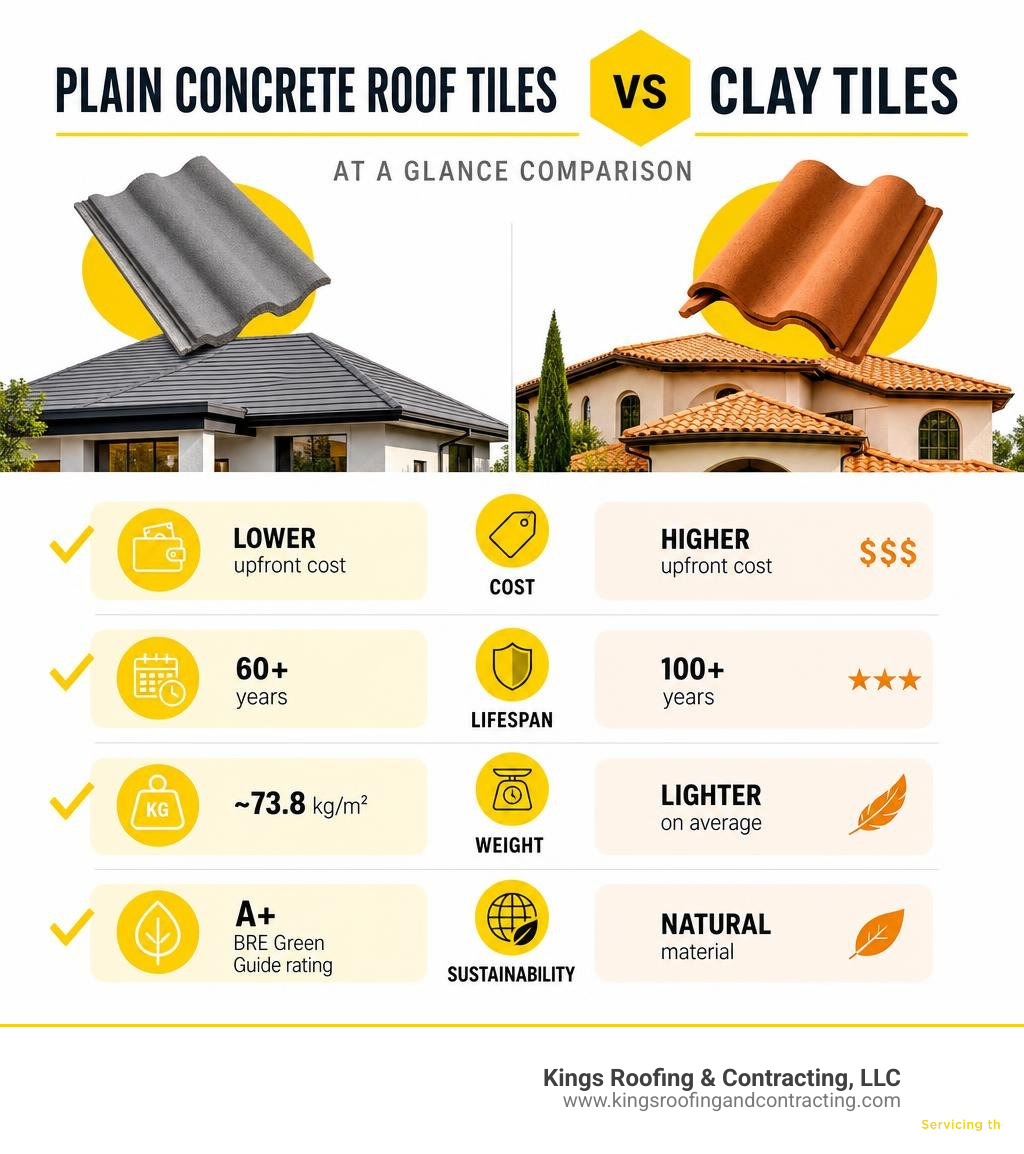
Plain concrete roof tiles are a popular, cost-effective alternative to clay tiles for pitched roofs. Here’s a quick comparison to help you decide:
| Feature | Plain Concrete Tiles | Clay Tiles |
|---|---|---|
| Cost | Lower upfront cost | Higher upfront cost |
| Weight | ~73.8 kg/m² | Lighter on average |
| Lifespan | 60+ years | 100+ years |
| Minimum Pitch | 35° | Varies (typically 35°+) |
| Maintenance | Low | Low |
| Eco Impact | A+ BRE Green Guide rating | Natural material |
Both are durable, long-lasting options. Concrete tiles win on price. Clay tiles win on longevity and natural character.
When Treasure Valley homeowners start researching tile roofing, the choice between clay and concrete comes up fast. It looks simple on the surface — two materials, one roof. But the differences in cost, weight, pitch requirements, and long-term performance can have a real impact on your home and your budget.
Professional roofing services that handle tile installations know this decision matters. Get it wrong and you’re dealing with cracked tiles, structural strain, or a roof that doesn’t suit your climate. Boise winters bring freeze-thaw cycles, wind, and snow loads — all of which put real stress on roofing materials. That changes the equation compared to milder climates. If you’re already dealing with issues on an existing tile roof, Boise roof repair is worth addressing before small problems become expensive ones.
I’m Ryan Santoro, owner of Kings Roofing & Contracting LLC, and with 24 years of construction experience — including hands-on work with plain concrete roof tiles across residential and commercial projects — I’ve seen how this material performs in real-world conditions. In this guide, I’ll walk you through everything you need to know to make a confident, informed choice.
What Are Plain Concrete Roof Tiles?

When we talk about plain concrete roof tiles, we are referring to a classic, highly versatile roofing material that has been a staple of residential and commercial architecture for decades. Unlike large-format profile tiles that feature deep waves or interlocking channels, plain tiles are smaller, flat rectangular units designed to be laid in a double-lap pattern.
The Concrete Composition
At their core, these tiles are manufactured from a precise mixture of Portland cement, graded sand, water, and pigments. This wet mix is extruded under immense pressure and heat-cured to achieve maximum structural density.
The resulting product is incredibly dense and tough. While traditional clay tiles rely on firing natural earth in a kiln, concrete relies on a chemical hydration process to cure and harden over time. In fact, concrete tiles actually get stronger as they age, continuing to cure when exposed to atmospheric moisture. This make-up allows manufacturers like Marley to produce exceptionally reliable options, such as the Plain Concrete Roof Tiles | Marley, which deliver traditional aesthetics backed by modern engineering.
For homeowners exploring residential roofing upgrades, plain concrete tiles offer a clean, timeless look that mimics the classic appearance of slate or handmade clay, but at a fraction of the cost.
Defining the Plain Tile Profile
To understand how plain tiles work, you must look at their profile—or rather, their lack of one.
- Flat Profile: Plain tiles are completely flat. They do not have the curved “S” shape of Spanish tiles or the raised rolls of Roman tiles.
- Non-Interlocking (Double-Lap): Unlike interlocking tiles that snap together at the sides, plain tiles rely on a double-lap system. This means that at any given point on your roof, there are actually three layers of tile overlapping to create a watertight barrier.
- Traditional Dimensions: Standard plain tiles are relatively small, typically measuring around 267mm x 168mm (roughly 10.5 x 6.5 inches).
As highlighted by manufacturers like FP McCann in their overview of Plain Roof Tiles | FP McCann, this simple rectangular shape allows for incredibly clean lines. It also provides the flexibility needed to cover complex roof shapes, including curved dormers, valleys, and tight hips, without leaving awkward gaps.
Aesthetic Options for Plain Concrete Roof Tiles
Modern manufacturing has completely transformed how plain concrete roof tiles look. Gone are the days when concrete meant a dull, industrial gray. Today, you can choose from a vast palette of colors and textures to match any architectural style in Boise, Eagle, or Meridian.
- Through-Coloured Pigmentation: The best concrete tiles are “through-coloured.” This means the pigment is mixed directly into the concrete before extrusion. If a tile is chipped by hail or a falling branch, the color remains uniform throughout, making the damage virtually invisible from the ground.
- Granular Finishes: These tiles feature a textured surface coated with mineral granules (similar to asphalt shingles). This finish diffuses light, giving the roof a softer, more rustic appearance that blends beautifully with traditional homes.
- Smooth Finishes: If you prefer a crisp, contemporary aesthetic, smooth-faced tiles provide sharp, clean shadow lines.
- Color Blends: From deep charcoal anthracite to warm, multi-toned options like “sunrise blend” and “mixed russet,” concrete tiles can accurately replicate the natural variations of weathered clay or premium slate.
Plain Concrete Roof Tiles vs. Clay: The Ultimate Comparison
Choosing between concrete and clay isn’t just about looks—it’s about how the material fits your budget, your home’s structure, and our local Idaho climate. Let’s break down how they stack up when you are planning a roof replacement.
Cost and Affordability
Concrete tiles are the undisputed champion of budget-friendliness in the tile roofing world.
Because concrete tiles are made from widely available raw materials (sand, cement, water) and cured using automated, energy-efficient extrusion lines, they are far cheaper to manufacture than clay. Clay tiles require specialized natural clays and high-temperature kilns that run for days, driving up production costs.
On average, concrete tiles cost 30% to 50% less for materials than clay tiles. While tile roofing of any kind requires highly skilled installation labor, the lower material cost of concrete makes a premium tile roof accessible to many more homeowners in Nampa, Caldwell, and the wider Treasure Valley.
Durability and Lifespan
While clay tiles can easily last over 100 years, modern concrete is no slouch. A professionally installed concrete tile roof will easily last 60+ years with proper maintenance.
For instance, the Forticrete Concrete Plain Tile comes with a 60-year product integrity guarantee. Concrete tiles are highly resistant to wind damage and carry Class A fire ratings.
In our Idaho climate, freeze-thaw resistance is critical. Water can seep into porous materials, freeze, expand, and crack the tile. Modern concrete tiles are engineered to meet strict BS EN 490 standards, ensuring low water absorption and excellent freeze-thaw endurance. Clay is also highly durable, but cheap, poorly fired clay tiles can delaminate or shatter in severe winters—making high-quality concrete a very reliable, predictable alternative.
Environmental Impact and Sustainability
If you are looking to build or renovate sustainably, concrete tiles offer surprising environmental benefits:
- Reduced Embodied Carbon: Advanced concrete mixes, like those used in Forticrete’s plain tiles, feature up to a 30% reduction in embodied CO2 (eCO2) compared to older manufacturing methods.
- Green Certification: Leading concrete plain tiles achieve an A+ environmental rating in the BRE Green Guide, the highest possible score for low environmental impact.
- Responsible Sourcing: Many concrete products carry BES 6001 accreditation, proving that raw materials are sourced responsibly.
- Eco-Friendly Coatings: Some modern flat tiles feature advanced acrylic polymer coatings that seal the surface, preventing dirt accumulation and reducing the growth of moss and algae without the need for harsh chemical treatments.
Technical Specifications, Pitch, and Installation Guidelines
Installing a tile roof is a highly technical process. Because tile is a heavy material, it must be installed in strict accordance with local building codes and standards like BS 5534 (the code of practice for slating and tiling). Proper roof installation requires a deep understanding of weight loads, pitches, and fixing specifications.
Weight, Size, and Load Requirements
Plain concrete tiles are small but heavy. Because they are laid in a double-lap pattern, they require a significant number of tiles to cover a single square meter of roof.
- Standard Tile Size: 267mm x 168mm (approx. 10.5″ x 6.5″).
- Individual Tile Weight: Approximately 1.25 kg (2.75 lbs).
- Covering Capacity: 60 tiles per square meter (at a standard 100mm gauge).
- Weight as Laid: Approximately 73.8 kg/m² (15.1 lbs/sq. ft.) on a roof.
Because of this weight, we must always evaluate your home’s structural roof support before starting an installation. If you are replacing a lighter material like asphalt shingles with concrete tiles, a structural engineer must verify that your rafters or trusses can handle the load.
Minimum Pitch and Weather Resistance
Roof pitch—the angle or slope of your roof—dictates what kind of tiles you can use.
- Standard Minimum Pitch: For standard plain concrete roof tiles, the absolute minimum pitch is 35 degrees. Anything lower runs the risk of wind-driven rain bypassing the double-lap design and causing leaks.
- Low-Pitch Alternatives: If your home has a lower slope, you don’t have to give up on the tile look. Modern interlocking flat tiles, such as The Planum Concrete Flat Tile, are engineered with deep weather-locks that allow them to be safely installed on pitches as low as 15 degrees (when installed with specific underlays and clips). Another excellent low-pitch option is The *Planum 2 Duo Concrete Flat Tile Roofing Tiles, which features a clever central groove to mimic the look of smaller plain tiles while offering the fast, secure installation of a large-format interlocking tile.
How to Identify and Match Plain Concrete Roof Tiles for Repairs
If you live in an older home in Kuna or Garden City with an existing tile roof, you may eventually need to replace a few broken tiles. Matching them can be a puzzle, especially if the original manufacturer has gone out of business or discontinued the profile.
To identify and match your tiles:
- Measure the Dimensions: Carefully measure the length, width, and thickness of an intact tile.
- Check the Back: Carefully remove a loose tile and look at the underside. Manufacturers often stamp their name, brand, or a specific product code into the concrete.
- Examine the Profile: Note whether the tile is completely flat, has a slight camber (curve), or has interlocking side channels. You can compare your tile’s profile with historic catalogs from major brands or look at resources like Flat Concrete Roof Tiles | – Eagle Roofing to see common flat profiles.
- Account for Weathering: Concrete tiles fade slightly over decades of exposure to the Idaho sun. If you buy brand-new replacement tiles, they may look slightly darker than your weathered roof. In these cases, sourcing matching tiles from salvage yards or using tiles from a less visible part of the house (like behind a chimney) for front-facing repairs is a pro trick we often use during routine roof maintenance.
Frequently Asked Questions
What is the minimum pitch for plain concrete tiles?
The standard minimum pitch for traditional, double-lapped plain concrete tiles is 35 degrees. For lower-pitched roofs down to 15 degrees, you should use specialized interlocking flat tiles like the *Planum Concrete Interlocking Flat Tile, Concrete Roof Tiles, Roofing Distribution UK Ltd., which provide advanced water-shedding channels at shallower angles.
How many plain concrete tiles do I need per square meter?
For standard 267mm x 168mm plain tiles laid at a traditional 100mm gauge (headlap of 65mm), you will need 60 tiles per square meter. However, if you choose a large-format flat interlocking tile like the Planum series, the coverage capacity drops significantly to just 9.8 tiles per square meter, which can reduce both material and labor costs.
Can concrete tiles be used for vertical cladding?
Yes! Plain concrete tiles are highly versatile and are frequently used for vertical tile hanging (cladding) on exterior walls, dormers, and eyebrow windows. When installed vertically, the minimum headlap requirement decreases to 37.5mm, which increases the maximum gauge to 115mm. This reduces the covering capacity to 53 tiles per square meter, making it an elegant and highly durable siding option.
Conclusion
When choosing between plain concrete and clay, there is no single “right” answer—only the option that fits your home’s structural limits, your aesthetic goals, and your budget.
If you want the ultimate in natural, historical character and don’t mind paying a premium upfront, clay is a beautiful choice. However, if you want a highly durable, fire-resistant, and wind-resistant roof with a 60+ year lifespan, modern design versatility, and a much lower price tag, plain concrete roof tiles are incredibly hard to beat.
At Kings Roofing & Contracting, LLC, we bring GAF-certified workmanship, transparent pricing, and 24/7 availability to every project across Boise, Meridian, Eagle, Nampa, and the surrounding areas. Whether you are ready for a complete tile roof replacement or need expert repairs on an existing tile roof, we are here to help.
Explore our full range of roofing services to see how we can protect your home. Ready to get started? Contact our friendly team online to schedule your professional roof consultation today!