Why Commercial Roof Installation in the Treasure Valley Demands the Right Contractor
Commercial roof installation in the Treasure Valley is one of the most significant investments a business owner or property manager can make — and one of the easiest to get wrong. Partnering with an experienced commercial roofing contractor in Boise ensures your property remains protected against Idaho’s harsh elements.
If you need a quick answer, here’s what matters most:
Top factors to evaluate for Treasure Valley commercial roofing:
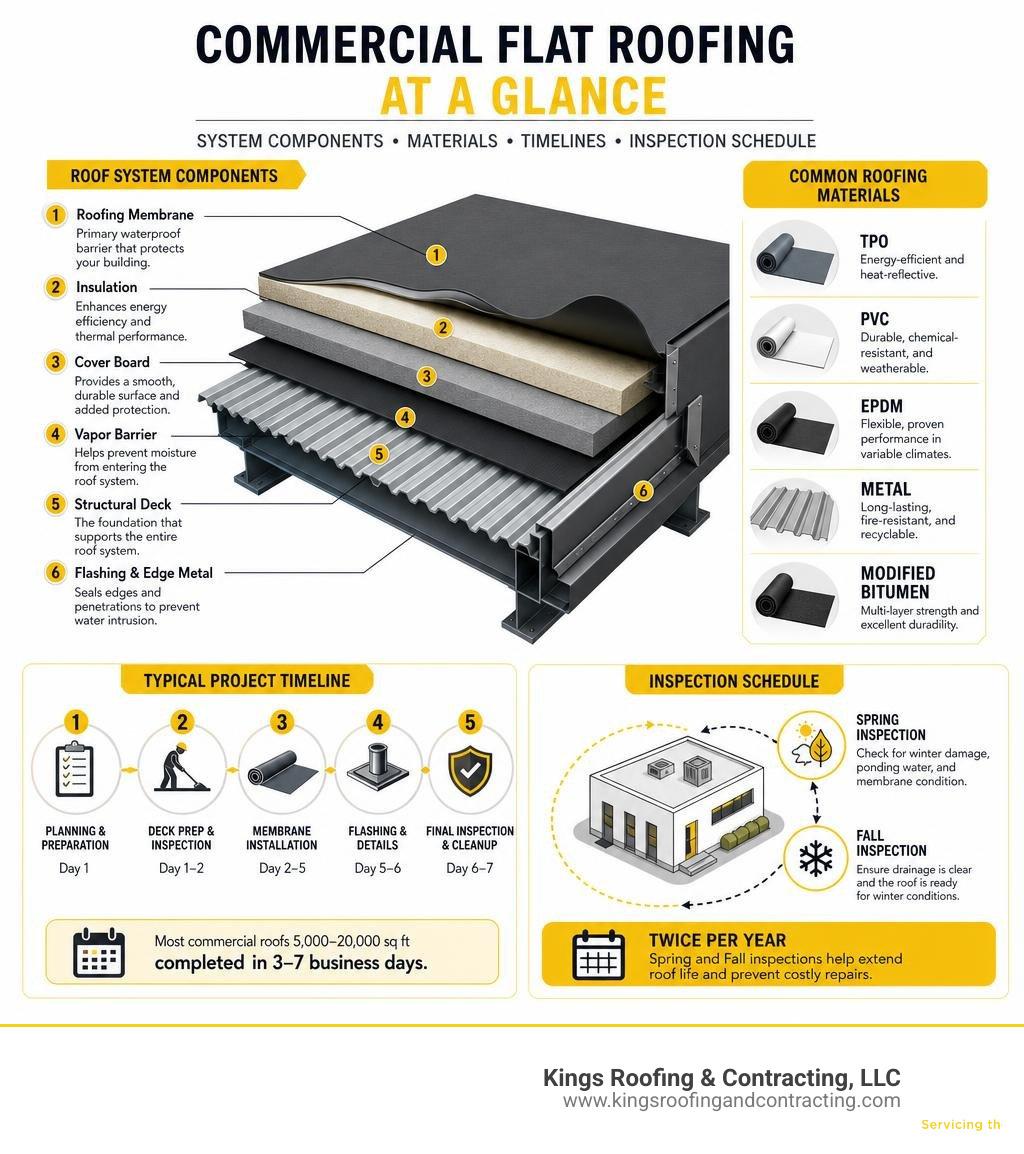
- Best materials: TPO, PVC, EPDM, metal, and modified bitumen are the most common systems for flat and low-slope commercial roofs in Idaho
- Typical project timeline: Most commercial roofs between 5,000 and 20,000 sq ft are completed in 3–7 business days
- Inspection schedule: Twice per year — spring and fall — is the industry standard
- Repair vs. replace: Repair works for isolated damage under 25% of the roof surface; replace when damage is widespread or the roof is past its rated lifespan
- Costs are driven by: Roof size, material type, insulation requirements, and local permitting
Idaho’s climate adds real pressure to commercial roofs. Extreme temperature swings, intense UV exposure, heavy snow loads, and freeze-thaw cycles break down membranes and flashings faster than in milder climates. A roof that performs well in Seattle may fail prematurely in Boise. That’s why local expertise isn’t just a selling point — it’s a practical necessity.
Kings Roofing & Contracting, LLC serves businesses across Boise, Meridian, Nampa, Caldwell, Eagle, and the broader Treasure Valley with roofing solutions built around Idaho’s specific conditions.
I’m Ryan Santoro, owner of Kings Roofing & Contracting, LLC, and I bring 24 years of construction experience across large commercial builds, flat roofing systems, and every major commercial roof installation type used in the Treasure Valley. That hands-on background shapes how my team approaches every project — from honest scoping to code-compliant installation that holds up for decades.
Key Factors in Commercial Roof Installation Treasure Valley
When planning a commercial roof installation treasure valley, you aren’t just buying material; you’re building a custom engineered defense system. The high-desert geography of Southwest Idaho requires a strategic approach to commercial roofing. What works in coastal or humid regions will quickly crack, warp, or leak under our intense summer sun and heavy winter snow.
To ensure your investment stands the test of time, you need experienced Boise Commercial Roofers who understand how local weather, structural loads, and building codes interact.

Understanding Idaho’s Climate Impact on Commercial Roofs
Southwest Idaho experiences dramatic four-season weather patterns that put immense structural stress on commercial buildings.
- Thermal Shock: In the Treasure Valley, temperature swings of 40 degrees or more in a single 24-hour period are common, especially during spring and autumn. This rapid shift causes commercial roof membranes to expand and contract aggressively. Over time, this constant movement stresses seams, pulls at perimeter flashings, and can cause physical buckling if the system is not properly fastened or adhered.
- Intense UV Exposure: With over 200 sunny days a year, commercial roofs in Boise, Meridian, and Nampa absorb high levels of ultraviolet radiation. UV rays accelerate the aging process of roofing materials, drying out oils in asphalt-based systems and degrading low-quality single-ply membranes. Selecting highly reflective, UV-resistant materials is critical to preventing premature cracking and failure.
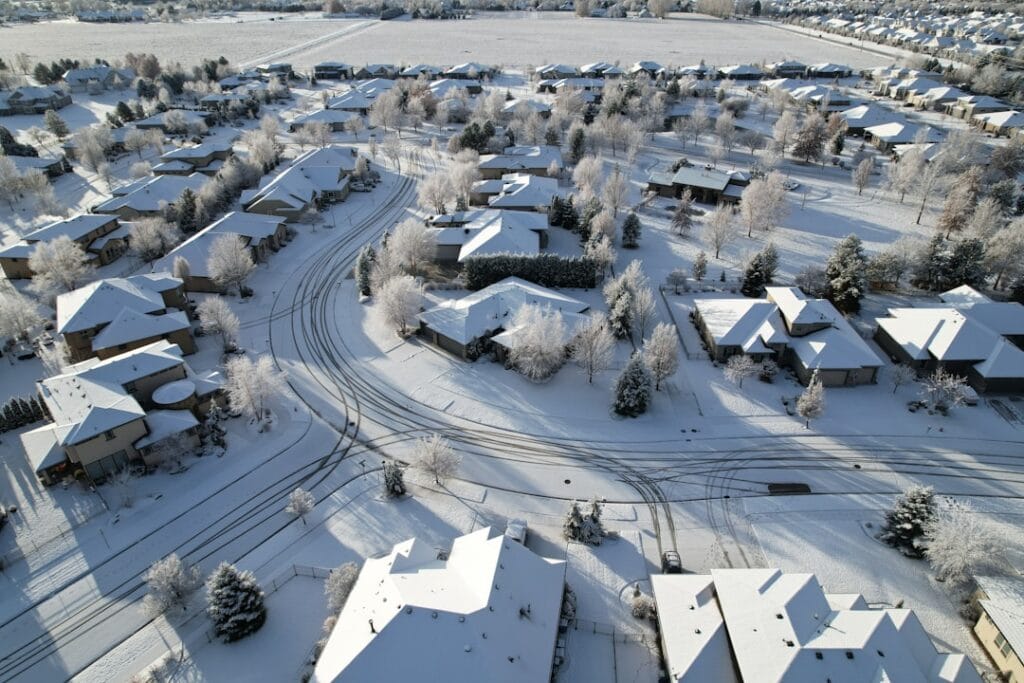
- Winter Snow Loads & Freeze-Thaw Cycles: Snow accumulation on flat or low-slope roofs creates substantial weight. As snow melts during the day and refreezes at night, ice dams can form around drains and scuppers. This trapped water undergoes volumetric expansion when freezing, widening microscopic cracks in seams and flashings.
- Ponding Water & Drainage Design: A functional flat roof must have a slight pitch (typically between 1/4 inch and 1/2 inch drop per foot) to direct water toward drainage points. Water sitting on a membrane for longer than 48 hours is classified as ponding water. This standing water adds dead weight, accelerates membrane degradation, and is the primary catalyst for commercial roof leaks in the region.
Local Building Codes and Permitting in Boise and Meridian
Every municipality in the Treasure Valley has distinct permitting requirements and code enforcement policies. Whether your facility is located in Boise, Meridian, Nampa, or Caldwell, your roofing project must comply with state and local amendments to the International Building Code (IBC) and International Energy Conservation Code (IECC).
In Boise, for example, building permits are strictly required for structural re-roofing projects, structural repairs, and any installation that alters the existing insulation values or structural weight. The City of Boise Building Codes mandate specific wind uplift ratings and thermal insulation R-values.
When performing commercial roofing services in Meridian or Nampa, local inspectors verify that the roof assembly meets thermal envelope requirements. This often means installing tapered polyisocyanurate (polyiso) insulation to achieve a minimum R-30 rating for flat roof replacements. Working with a commercial contractor who handles the entire municipal permitting process ensures your project is legally compliant and passes final inspections without costly delays.
Comparing Commercial Roofing Systems for Idaho Businesses
Selecting the right material is the foundation of a successful commercial roofing project. Every building has unique requirements based on its slope, structural load capacity, usage, and budget.
To help you make an informed decision, we install and service a variety of high-performance Flat Roof Systems designed to withstand Southwest Idaho’s climate.
| Roofing Material | Average Lifespan | Solar Reflectivity | Relative Cost | Best Suited For |
|---|---|---|---|---|
| TPO (Thermoplastic Polyolefin) | 20–30 Years | Very High (Up to 80%) | Moderate | Retail, offices, warehouses, and energy-conscious facilities |
| PVC (Polyvinyl Chloride) | 20–30+ Years | High | Higher | Restaurants, chemical plants, and roofs exposed to oils/grease |
| EPDM (Rubber) | 25–30+ Years | Low (Unless coated white) | Moderate | Large open warehouses, low-foot-traffic industrial spaces |
| Metal Roofing | 50+ Years | Moderate to High | High | Sloped commercial builds, schools, municipal buildings |
| Modified Bitumen | 15–20 Years | Low | Moderate | High-foot-traffic roofs, multi-ply configurations |
TPO and PVC Single-Ply Membranes
Single-ply thermoplastic membranes are the modern gold standard for flat and low-slope commercial buildings in the Treasure Valley.
TPO (Thermoplastic Polyolefin) has rapidly become the most popular choice for local businesses. It is composed of a blend of polypropylene and ethylene-propylene rubber. White TPO membranes can reflect up to 80% of solar heat, acting as a “cool roof” that substantially reduces HVAC strain during Boise’s hot summer months. TPO seams are hot-air welded rather than glued, creating a monolithic, watertight barrier that is highly resistant to punctures and tears. For premium performance, we work with top-tier manufacturers like Carlisle SynTec Systems to deliver industrial-grade installations.
PVC (Polyvinyl Chloride) shares many benefits with TPO, including heat-welded seams and excellent reflectivity. However, PVC offers superior resistance to chemicals, grease, animal fats, and fire. This makes PVC the ideal choice for restaurants, food processing facilities, and manufacturing plants along the I-84 industrial corridor.
EPDM Rubber and Modified Bitumen Systems
For properties requiring time-tested durability under heavy-duty conditions, traditional systems remain highly viable.
EPDM (Ethylene Propylene Diene Monomer) is a synthetic rubber membrane known for its exceptional elasticity and resistance to extreme cold. EPDM handles freeze-thaw cycles and thermal shock remarkably well. While traditionally black (which absorbs heat), white EPDM options are available. EPDM is typically installed using adhesive or mechanical fasteners and is highly valued for its long-term resistance to ozone and weathering.
Modified Bitumen is an evolution of traditional built-up (asphalt) roofing. It combines polymer-modified asphalt with polyester or fiberglass reinforcement layers. Installed in multiple plies, modified bitumen provides excellent puncture resistance and is highly suited for commercial roofs that experience frequent foot traffic from HVAC maintenance crews.
Long-Lasting Metal Roofing Systems
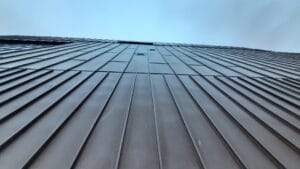
If you are looking for a commercial roof with the longest possible lifecycle, a standing-seam Metal Roofing system is unmatched.
With a lifespan often exceeding 50 years, metal roofs require very little maintenance and offer exceptional wind and fire resistance. They are highly effective on pitched commercial structures, such as churches, schools, retail centers, and office parks throughout Eagle and Meridian. Metal roofing does not dry out, crack, or rot, making it a highly durable, sustainable, and aesthetically premium choice for local businesses.
Repair, Restoration, or Replacement: Making the Right Choice
As a property manager or business owner, your roof is one of your largest physical liabilities. When a leak occurs, deciding whether to patch, restore, or completely replace the system is a high-stakes financial decision.
Making the right choice requires a systematic approach, beginning with a professional Roof Replacement assessment and diagnostic testing.
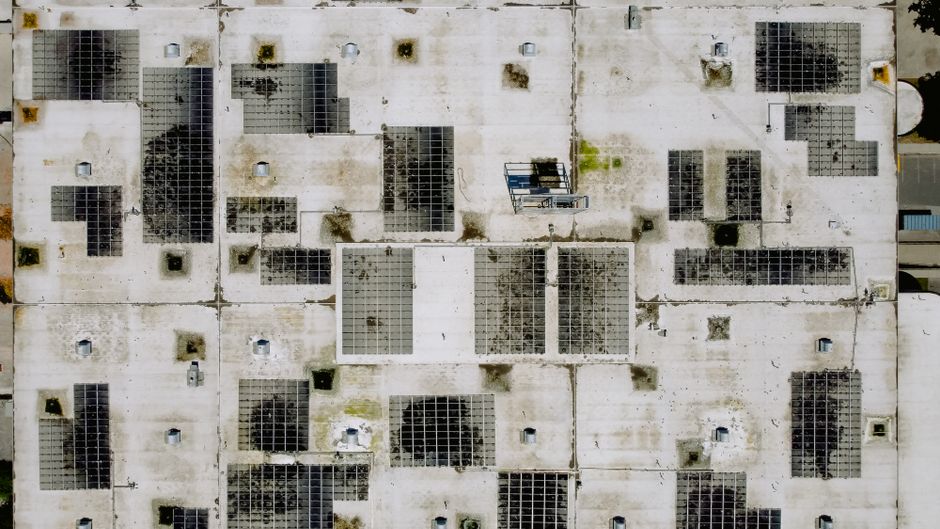
To help you navigate this decision, we use a simple rule of thumb based on industry standards:
- Age of the Roof: If the system is within its first 50-60% of its rated lifespan and has been well-maintained, repair or restoration is usually favored.
- Damage Percentage: If physical damage or active leaking affects less than 25% of the total roof area, localized repairs are highly cost-effective. If damage exceeds 25%, a full replacement is generally more economical over a 3-to-5-year window.
- Insulation Integrity: If the underlying polyiso insulation boards are dry, the roof is a candidate for repair or a liquid-applied coating. If the insulation is saturated with trapped water, a full tear-off is required to prevent mold, rot, and structural sagging.
We utilize advanced diagnostic tools, including infrared moisture detection, to locate hidden water trapped beneath the membrane without making invasive cuts. This thermal imaging technology allows us to pinpoint exact wet areas, saving our clients thousands of dollars by avoiding unnecessary full tear-offs when a targeted repair or restoration is possible.
When to Choose Commercial Roof Repair
Localized Boise Roof Repair is the best course of action when dealing with isolated issues on a relatively young, structurally sound roof. Common scenarios that warrant immediate repair include:
- Failing Seams: Single-ply membranes can occasionally suffer from localized seam separation due to poor initial installation or excessive structural movement. Re-welding or patching these seams restores watertight integrity.
- Flashing Failures: Over 90% of commercial roof leaks originate at flashing details around penetrations (pipes, HVAC curbs, drains) or along parapet walls. Repairing or replacing damaged flashings resolves the leak immediately.
- Puncture Damage: Wind-blown debris, hail, or careless foot traffic from service technicians can puncture membranes. These small holes can be easily patched using matching membrane material and heat-welding or specialized sealants.
The Benefits of Commercial Roof Coatings and Restoration
Commercial roof restoration is an incredibly effective middle-ground solution that bridges the gap between minor repairs and a costly replacement. Restoration involves applying a high-performance, liquid-applied elastomeric, silicone, or acrylic coating directly over your existing, structurally sound membrane.
Key benefits of commercial roof restoration include:
- Life Extension: A professional roof coating can extend the life of an existing commercial roof by 10 to 15 years.
- Seamless Protection: Liquid coatings cure to form a completely seamless, monolithic membrane over the entire roof surface, eliminating seams — the most common point of failure.
- Cost Savings: Restoration typically costs 50-70% less than a full tear-off and replacement because it eliminates landfill disposal fees and reduces labor hours.
- Tax and Energy Advantages: Because restoration is classified as maintenance rather than a capital improvement, it can often be fully expensed in the first year. Additionally, white silicone coatings provide excellent solar reflectivity, reducing cooling energy costs by up to 12%.
When a Full Commercial Roof Installation Treasure Valley Is Required
There are circumstances where repairs or coatings are no longer viable, and a full commercial roof installation treasure valley is the only safe, code-compliant option.
A full replacement is required when:
- Widespread Insulation Saturated: If thermal imaging reveals that water has infiltrated and saturated more than 25-30% of the underlying insulation, the wet material must be torn out to protect the building’s structural deck.
- Structural Sagging or Deck Rot: Years of slow, unaddressed leaks can rot plywood, OSB, or steel decking. If the roof deck is structurally compromised, a complete tear-off is mandatory to ensure safety.
- End of Rated Lifespan: An aging, brittle membrane that has reached the end of its natural lifecycle will continue to develop new leaks faster than they can be repaired. Investing in a new, warrantied system is the only way to achieve long-term peace of mind and protect your inventory, equipment, and operations.
Planning Your Commercial Roofing Project: Timelines, Costs, and Safety
A major roofing project can feel overwhelming, but proper planning and clear communication make all the difference. We pride ourselves on structured project management, keeping our clients informed from initial consultation to final closeout.
Typical Timelines and Costs for Treasure Valley Projects
We understand that time is money for your business. Fortunately, modern commercial roofing installations are highly efficient. Most commercial roof replacement projects in the 5,000 to 20,000 sq ft range are completed in 3 to 7 business days, depending on the complexity of the roof, weather conditions, and the amount of old material that needs to be torn off.
Commercial roofing costs are highly variable and depend on several factors:
- Roof Size and Layout: Larger roofs benefit from economies of scale, while roofs with numerous HVAC units, pipes, skylights, and parapet walls require more detail-oriented, labor-intensive work.
- Material Selection: TPO and EPDM are generally more cost-effective upfront, while PVC and standing-seam metal systems represent a higher initial investment with lower long-term maintenance costs.
- Insulation Requirements: Meeting modern energy codes (R-30 insulation value) requires thicker layers of polyiso insulation, which impacts overall material costs.
- Tear-Off vs. Recover: If local building codes allow, installing a new membrane directly over an existing single-layer roof (a “recover”) saves significant labor and disposal costs compared to a full tear-off.
To get an accurate, transparent estimate tailored to your building, you can easily request a Free Roof Quote from our team.
Minimizing Operational Disruption and Ensuring Safety
Our top priority during any commercial project is ensuring your business operations continue with minimal disruption. We work closely with property managers to coordinate logistics, material deliveries, and staging areas.
- Flexible Scheduling: To avoid disrupting your tenants, customers, or employees, we offer night and weekend scheduling for high-noise phases of the project, such as tear-offs or crane operations.
- Rigorous Safety Standards: We maintain a clean, organized job site and strictly adhere to OSHA safety standards. Our crews are fully trained in fall protection, personal protective equipment (PPE), and hazardous material handling.
- Insurance and Liability Protection: We provide comprehensive general liability insurance, workers’ compensation coverage, and job-specific safety plans before any work begins, protecting your business from liability.
Maximizing ROI: Warranties, Insurance Claims, and Financing
A new commercial roof is a major capital investment, and maximizing your return on investment (ROI) requires looking beyond the initial installation cost to evaluate long-term performance, warranty protection, and financing options.
If you are looking to manage upfront cash flow, we offer flexible Financing options designed to fit your business’s budget.
Navigating Commercial Insurance Claims for Storm Damage
The Treasure Valley occasionally experiences severe weather, including high windstorms and heavy hail. If your property has suffered sudden storm damage, navigating the commercial insurance claims process can be complex.
We have extensive experience with Storm Damage Roofing and insurance claim assistance. We provide:
- Detailed Damage Documentation: We perform comprehensive inspections, using high-resolution photos and drone imaging to document membrane punctures, wind uplift, and flashing damage.
- Adjuster Coordination: We meet with your insurance adjuster on-site to review the damage together, ensuring all issues are documented and covered under your policy.
- Accurate Scope of Work: We prepare detailed, itemized estimates to ensure your insurance payout covers the full cost of code-compliant repairs or replacement.
Manufacturer Warranties and Factory Certifications
Your roof’s long-term protection relies heavily on the quality of the manufacturer’s warranty. As a factory-certified contractor, we can offer premium, extended warranties that uncertified roofers cannot provide.
We work with industry-leading manufacturers like GAF Commercial Roofing to deliver high-performance installations backed by robust warranties.
- NDL (No Dollar Limit) Warranties: For ultimate peace of mind, we can provide NDL manufacturer warranties spanning 10, 15, 20, or even 25 years. Under an NDL warranty, the manufacturer covers the full cost of labor and materials to repair any covered leak, with no financial cap, for the duration of the warranty.
- Workmanship Warranties: In addition to manufacturer material warranties, we back our installations with our own comprehensive workmanship warranties, ensuring any installation-related issues are corrected promptly and professionally.
Long-Term Cost Savings and Energy Efficiency
Investing in a high-performance commercial roof pays dividends through ongoing operational savings.
- Reduced Energy Bills: Highly reflective cool roofs (like white TPO or PVC) reflect up to 80% of solar heat, lowering ambient roof temperatures and reducing cooling energy costs by 10-15%.
- Extended HVAC Lifespan: By reducing heat transfer into your building, a cool roof lowers the workload on your rooftop HVAC units, extending their operational lifespan and reducing maintenance costs.
- Tax Incentives: Section 179 of the tax code allows businesses to deduct the full cost of qualifying commercial roof replacements or restorations in the year the work is completed, rather than depreciating the asset over 39 years.
Proactive Maintenance: Extending Your Commercial Roof’s Lifespan
The single most effective way to protect your investment and avoid costly emergency repairs is implementing a proactive Roof Maintenance program. Studies show that commercial roofs with regular maintenance programs experience 40-60% fewer unplanned repairs and last up to 50% longer than neglected roofs.
The Importance of Spring and Fall Roof Inspections
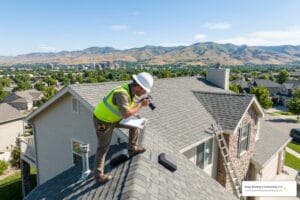
We recommend scheduling professional Roof Inspections at least twice a year — once in the spring and once in the fall.
- Spring Inspections: Focus on assessing the roof after winter weather, checking for freeze-thaw damage, membrane shrinkage, flashing cracks, and clearing any debris or ice dams from drains.
- Fall Inspections: Prepare the roof for winter snow loads by ensuring all seams are watertight, drains are clear, and flashings are secure.
Best Practices for Commercial Roof Installation Treasure Valley Maintenance
Our maintenance crews handle several critical tasks to keep your roof in peak condition:
- Drainage and Gutter Clearing: We clear leaves, dirt, and debris from drains, scuppers, and gutters to prevent ponding water and structural overloading.
- Seam and Flashing Audits: We inspect all welded seams and flashing details, re-securing any areas showing signs of separation or wear.
- Debris and Vegetation Removal: Wind-blown trash, branches, and organic material can trap moisture and damage membranes. We keep your roof surface clean and clear.
- Detailed Inspection Logs: We document all inspections, repairs, and maintenance activities with photos and written reports, maintaining a complete paper trail that is essential for preserving your manufacturer warranty.
Frequently Asked Questions About Commercial Roofing
How long does a commercial roof replacement take in the Treasure Valley?
Most commercial roof replacement projects in the 5,000 to 20,000 sq ft range are completed in 3 to 7 business days. The exact timeline depends on the roof’s size, the complexity of the layout, the number of penetrations, weather conditions, and whether a full tear-off of old materials is required.
What is the most energy-efficient flat roof material for Idaho businesses?
TPO (Thermoplastic Polyolefin) is highly regarded as the most energy-efficient flat roof material for our climate. White TPO membranes reflect up to 80% of solar heat, reducing heat absorption and lowering cooling energy costs during the hot summer months.
How often should a commercial roof be inspected?
Commercial roofs should be inspected at least twice a year — once in the spring and once in the fall. Regular inspections allow you to catch minor issues, like minor seam separations or clogged drains, before they turn into costly water damage.
Conclusion
Your commercial roof is the first line of defense protecting your business, employees, inventory, and operations. Investing in a high-quality commercial roof installation or proactive maintenance program is a critical step in securing your property’s long-term value.
At Kings Roofing & Contracting, LLC, we bring 24 years of hands-on experience, GAF-certified workmanship, transparent pricing, and 24/7 availability to every project. Whether you need a full TPO replacement, a silicone roof restoration, or immediate leak repairs, our team is ready to deliver the reliable, high-performance results your business deserves.
Protect your commercial investment today. Request a Free Roof Quote online to schedule your professional commercial roof assessment.