What Is Tile Roofing — and Is It Right for Your Home?
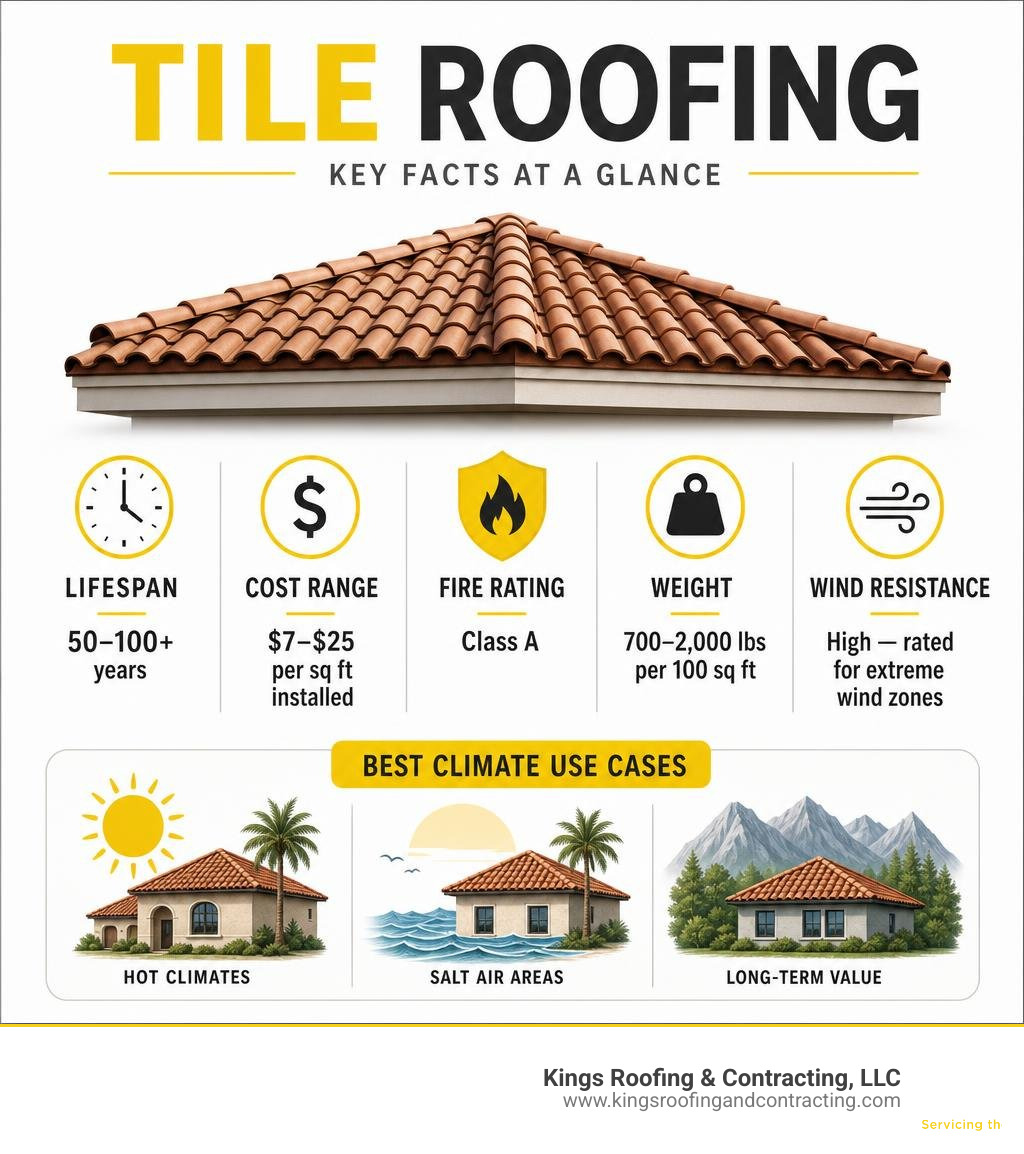
Tile roofing is one of the most durable and visually striking options available to homeowners today. If you’re weighing your options, here’s a quick snapshot:
| Feature | Tile Roofing |
|---|---|
| Lifespan | 50–100+ years |
| Cost | $7–$25 per square foot installed |
| Fire Rating | Class A |
| Wind Resistance | High — rated for extreme wind zones |
| Weight | 700–2,000 lbs per 100 sq ft |
| Best For | Hot climates, salt air, long-term value |
| Maintenance | Low — occasional repairs only |
Tile roofs have protected homes for centuries — and for good reason. Clay and concrete tiles resist fire, wind, hail, and heavy rain better than almost any other roofing material on the market. They also last longer, often outliving the homes they’re installed on.
That durability comes with trade-offs. Tile is heavy, costs more upfront, and requires proper structural support. It’s not the right fit for every home or every budget.
But for Treasure Valley homeowners who want a roof they’ll never have to replace again, tile is worth a serious look. At Kings Roofing & Contracting, we help homeowners across Boise, Meridian, and Nampa understand exactly what tile roofing involves — before they commit.
I’m Ryan Santoro, owner of Kings Roofing & Contracting LLC, and with 24 years of construction experience across residential and commercial builds, I’ve worked with concrete tile, clay tile, and a wide range of roofing systems. I put together this guide to give you a straight, no-fluff look at everything tile roofing involves — from profiles and installation to cost and long-term value.
Understanding the Basics of Tile Roofing
To fully appreciate tile roofing, it helps to understand that a tile roof is not just a collection of overlapping shingles. It is a highly engineered, multi-layered water-shedding assembly.
Unlike fully waterproof membranes used in some flat roofing options, a tile roof functions by shedding water down its surface. The tiles themselves act as a protective, weather-resistant shield, while the underlayment beneath them serves as the secondary line of defense against moisture.
Modern roof tiles are manufactured from natural, earth-born materials. The two most common types are clay and concrete:
- Clay tiles are crafted from natural clay, molded into shape, and baked in high-temperature kilns. This process vitrifies the clay, fusing the minerals together to create an incredibly hard, color-fast, and chemically inert material.
- Concrete tiles are made from a precise mixture of Portland cement, sand, water, and natural iron oxide pigments. They are cured under controlled temperatures to achieve high structural strength.
When choosing between different types of roofing, homeowners often upgrade to tile because it offers unmatched protection. At Kings Roofing & Contracting, we install these advanced residential roofing systems to ensure your home remains safe, dry, and energy-efficient through every season. Whether you require minor repairs or a complete system design, our professional roofing services are tailored to handle the unique weight and installation demands of tile.
Clay vs. Concrete: Types and Profiles of Roof Tiles

When selecting the perfect tile for your home, the first decision is choosing between clay and concrete. While they share some similarities, their physical properties, performance standards, and lifespans differ significantly.
For a deep dive into how these two materials compare, check out our guide on plain concrete roof tiles vs clay. Below is a breakdown of their primary differences:
- Standards and Testing: Clay tiles must comply with ASTM C1167, which classifies tiles by their resistance to severe frost and freeze-thaw cycles. Concrete tiles must meet ASTM C1492, which measures physical properties like breaking strength and dimensional tolerances.
- Water Absorption: Clay tiles have incredibly low water absorption rates. Premium clay tiles, such as those detailed in the Ludowici Architectural Terra Cotta Catalog, absorb less than 2% moisture. This prevents water from entering the tile and cracking during freezing winter nights. Concrete tiles are more porous, typically featuring a moisture absorption rate of around 13%. This requires concrete tiles to be periodically resealed to prevent water logging and freeze-thaw damage.
- Lifespan and Color Performance: High-quality clay tiles can easily last 100 years or more. Because their colors are fired directly into the clay or sealed with ceramic glazes, they are completely impervious to UV fading. Concrete tiles have a practical lifespan of 30 to 50 years. Their color is either mixed into the wet concrete slurry or applied as a surface coating, meaning they will gradually fade over decades of exposure to the hot Idaho sun. Excellent options from manufacturers like Eagle Roofing Products offer a wide range of concrete profiles engineered to withstand heavy weathering.
Popular Profiles in Tile Roofing
The shape, or “profile,” of your roof tiles defines your home’s architectural style. Roof tiles generally fall into three profile categories: high-profile (curved), medium-profile (low wave), and flat.
- Spanish S-Tile: The classic “S” shape creates a beautiful undulating pattern across the roof. It is a single piece that mimics the traditional two-piece barrel design, offering a classic Mediterranean look with a faster installation process.
- Mission Barrel: A traditional two-piece system consisting of alternating “pans” (bottom tiles) and “covers” (top tiles). This profile offers maximum depth and shadow lines, making it popular for custom luxury homes.
- Flat Shake: Designed to mimic the rustic texture of natural wood shakes or slate. Flat concrete shakes provide a clean, modern aesthetic with the superior fire and rot resistance of tile.
- French: A robust interlocking profile with deep water channels. French tiles lie flat on the roof and offer exceptional water-shedding capabilities in areas prone to heavy, driving rain.
- Double Roman: A medium-profile tile featuring a double-arch shape. It creates a subtle, gentle wave pattern across the roofline, blending traditional warmth with modern structure.
- Scandia: A reverse-curve profile that delivers a distinct, sharp-lined European look, perfect for adding unique curb appeal to contemporary designs.
The Pros and Cons of Tile Roof Systems
Before investing in a tile roof, it is important to weigh its outstanding performance against its structural and financial requirements. The table below compares tile to other common residential materials:
| Performance Metric | Tile Roofing (Clay/Concrete) | Asphalt Shingles | Metal Roofing |
|---|---|---|---|
| Average Lifespan | 50 to 100+ Years | 15 to 30 Years | 40 to 70 Years |
| Average Installed Cost | $7 – $25 / sq. ft. | $4 – $10 / sq. ft. | $8 – $18 / sq. ft. |
| Weight per Square (100 sq ft) | 700 to 2,000 lbs | 275 to 425 lbs | 100 to 150 lbs |
| Wind Resistance | Up to 150+ mph | 110 to 130 mph | 140+ mph |
| Fire Rating | Class A (Non-combustible) | Class A | Class A (Typically) |
| Impact Resistance | Class 4 Available | Class 1 to 4 | Class 4 |
While tile roofing offers unparalleled durability, its heavy weight is a critical factor. Clay tiles can weigh up to 2,000 pounds per square, and concrete tiles weigh around 700 pounds per square.
If you are replacing lightweight asphalt shingles with tile, your home’s framing must be evaluated by a structural engineer. If the rafter system cannot support this “dead load,” structural reinforcement will be required before we can perform a complete roof replacement.
Weather Resistance and Energy Efficiency of Tile Roofing
One of tile’s greatest strengths is its natural resistance to extreme weather. Both clay and concrete tiles carry a Class A fire rating, meaning they are completely non-combustible and provide an essential barrier against flying embers. Many insurance companies offer premium discounts for homes protected by Class A tile roofs.
Additionally, high-quality tiles are tested for Class 4 impact resistance, allowing them to withstand heavy hail strikes without cracking. In high wind zones, tile roofs perform exceptionally well due to their weight and interlocking designs.
Tile roofs are also incredibly energy-efficient. Because of their high thermal mass, tiles absorb heat during the day and release it slowly at night, preventing heat from radiating directly into your attic.
When installed using elevated battens, tile roofs benefit from “above-sheathing ventilation.” According to the TRI Alliance 2024 Installation Guide, this air gap allows heat to escape before entering the home, reducing cooling costs by up to 20% compared to standard asphalt shingle roofs.
Essential Components and Installation Best Practices
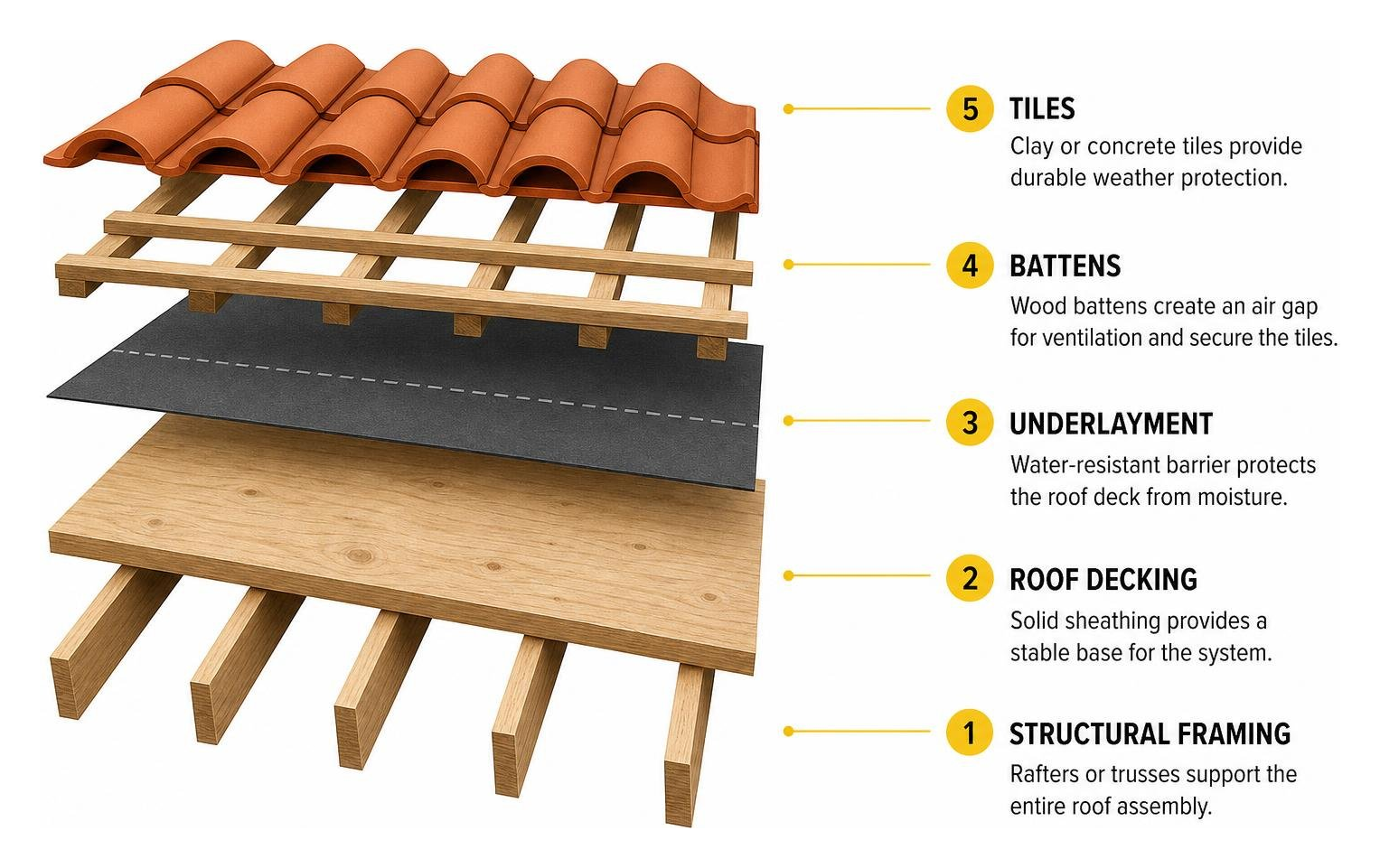
Because a tile roof is a water-shedding system, its longevity depends entirely on the quality of its underlying components. Skimping on the underlayment or flashing will result in premature system failure, even if the tiles themselves remain in perfect condition.
At Kings Roofing & Contracting, our team follows strict industry standards to ensure every expert roof installation is built to last.
1. The Roof Deck and Underlayment
The roof deck must be smooth, clean, dry, and constructed of at least nominal 1-inch lumber or 15/32-inch plywood. Because tiles let some water pass through their joints, the underlayment must be robust.
- For moderate slopes, we install at least two layers of ASTM D226 Type II (No. 30 felt) or ASTM D4869 Type IV underlayment.
- For maximum protection, we recommend a high-performance, self-adhering modified bitumen membrane meeting ASTM D1970 standards.
2. Battens and Counter-Battens
On steeper roofs, tiles are hung on wood battens. We use nominal 1×2 wood battens secured to the deck.
To prevent water from getting trapped behind horizontal battens, we install vertical counter-battens first. This creates a clear drainage plane, allowing water and air to flow freely beneath the tiles.
3. Flashing and Valleys
Valleys are highly vulnerable areas. We install minimum 26-gauge galvanized sheet metal valley flashing that extends at least 11 inches (or 12 inches depending on regional code specifications) from the center. It must include a 1-inch-high splash diverter rib to prevent water from rushing under the tiles on the opposite side.
Malleable metal flashing (such as soft lead or dead-soft aluminum) is carefully formed around profile tiles to seal penetrations.
For detailed technical specifications on high-wind configurations and specialized flashing layouts, professional installers refer to the TRI Concrete and Clay Roof Tile Installation Manual and the Florida High Wind Concrete and Clay Tile Installation Manual.
Cost, Maintenance, and Long-Term Value
Installing a tile roof requires a significant upfront investment. On average, the cost to install a tile roof runs from $7 to $25 per square foot, depending on the tile material (concrete is generally more affordable than clay), the complexity of your roofline, and whether your home requires structural reinforcement.
However, when you analyze the long-term return on investment (ROI), tile often proves to be the most cost-effective choice. While an asphalt roof must be replaced every 15 to 25 years, a tile roof can easily last a century.
Furthermore, a beautifully maintained tile roof dramatically enhances your home’s curb appeal and can significantly increase your property value.
Maintenance and Safety Requirements
While tile is low-maintenance, it is not no-maintenance. Homeowners should schedule professional inspections every few years to check for:
- Accumulated leaves or debris in the valleys and gutters, which can back up water.
- Cracked or broken tiles caused by falling tree branches or heavy impact.
- Degraded underlayment or flashing at roof penetrations.
Replacing a broken tile is a straightforward process, but it must be handled by a professional. Walking on a tile roof requires specialized techniques to avoid cracking adjacent tiles.
Additionally, safety is paramount during installation and repairs. When tiles are cut dry, they release crystalline silica dust, which is hazardous to inhale. Our crews strictly follow OSHA safety guidelines, utilizing wet-cutting saws and proper respiratory protection to eliminate dust hazards.
Frequently Asked Questions About Tile Roofs
How long does a tile roof last?
A high-quality clay tile roof can easily last over 100 years when installed correctly in the right climate. Concrete tile roofs typically have a lifespan of 30 to 50 years, though the underlayment beneath both systems may need to be replaced after 30 to 40 years.
Can my house support the weight of a tile roof?
It depends on your home’s original construction. Tile roofs are heavy, weighing between 700 and 2,000 pounds per square. If your home was originally built for asphalt shingles, a structural engineer must evaluate your roof framing and recommend reinforcement if necessary.
How much does it cost to install a tile roof?
The total cost typically ranges from $7 to $25 per square foot installed. Materials generally average around $6 per square foot, while specialized labor and structural preparation make up the remainder of the investment.
Conclusion
A tile roof is more than just a home upgrade; it is a lifetime investment in durability, safety, and timeless architectural beauty. From the freeze-thaw cycles of Caldwell and Kuna to the hot summer days of Meridian and Eagle, tile roofing provides a premium shield that stands up to Idaho’s diverse climate.
If you’re ready to explore whether clay or concrete tile is the right choice for your home, the team at Kings Roofing & Contracting, LLC is here to help. Located in Boise, Idaho, we bring decades of hands-on expertise, transparent pricing, and GAF-certified precision to every project.
Don’t leave your home’s ultimate protection to chance. For expert advice or to schedule a professional inspection, explore our Boise roof repair services or request a free roof quote today.
Ready to speak with our team? Call us at (208) 314-1111 to discuss your roofing needs!